
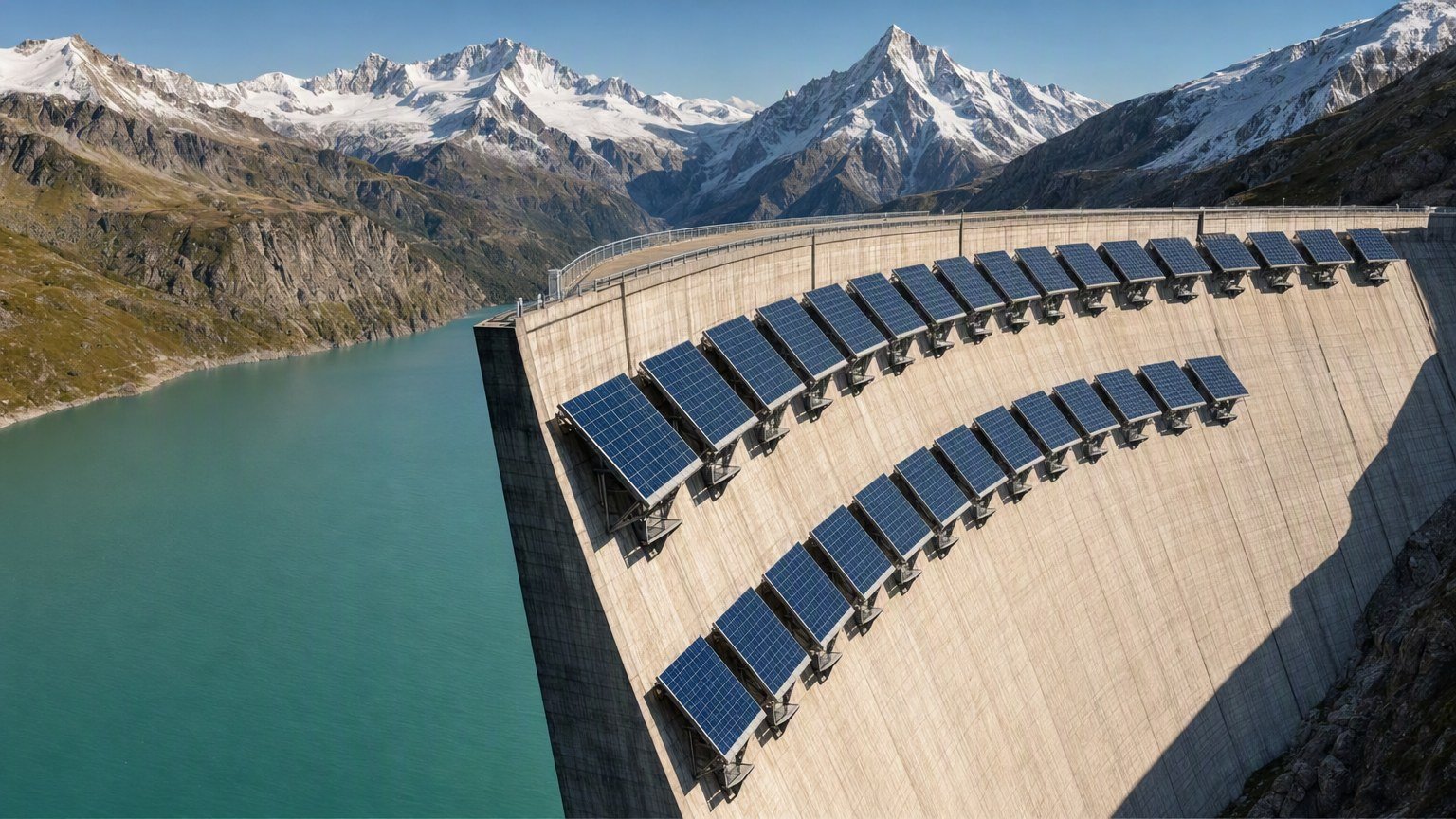
They flew a crane up a mountain in pieces, reassembled it at 2,500 meters, and built a solar farm on the side of a dam. And honestly? It’s kind of working.
They flew a crane up a mountain in pieces, reassembled it at 2,500 meters, and built a solar farm on the side of a dam. And honestly? It’s kind of working.
The Muttsee dam in the Swiss Alps now hosts what might be the best answer yet to solar power’s most annoying problem – the fact that it produces almost nothing during winter, right when Europe needs electricity most. This isn’t some experimental pilot project anymore. AlpinSolar hit full operation in August 2022, and after its first measured year, the numbers are actually impressive.
Winter Output That Doesn’t Completely Suck
Here’s what matters: between October 2022 and September 2023, the installation generated 616 kilowatt-hours per installed kilowatt during the winter half-year. That’s 3.8 times higher than a reference plant down in the Swiss lowlands near Payerne.

Now, before we get too excited – the reference sites apparently had a rough time from January through May that year, which made the gap look even better. One year of data is solid, but it’s not a 20-year track record. Still, 3.8 times is 3.8 times.
The annual yield came in at 1,434 kilowatt-hours per installed kilowatt. For context, that’s the kind of performance that makes lowland solar developers a little jealous.
Why Mountains Are Better at This (Sometimes)
It’s not magic. It’s altitude, orientation, and physics doing their thing.
First, the plant sits above Switzerland’s fog belt. While lowland panels are sitting under gray soup for weeks at a time in winter, these panels are up in clear air getting actual sunlight. That alone is huge.
Second – and this surprised me when I first learned it – cold temperatures actually help solar panels work better. Photovoltaic cells get more efficient when they’re cold. So while you’re freezing at sea level and your panels are underperforming, these alpine installations are running in optimal conditions.
Third, the dam face itself is oriented to catch winter sun consistently. Panel mounting angles matter more than people think, and when you’re working with a massive concrete surface that’s already angled the right way, you’ve got a built-in advantage.
The Logistical Nightmare Was Worth It
Let’s go back to that crane for a second. They had to dismantle it in the valley, fly every piece up by helicopter, and put it back together at altitude just to start construction. That’s not normal project logistics. That’s the kind of thing that makes project managers wake up sweating.

But here’s the thing – if you’re trying to solve Europe’s winter electricity problem, this kind of ambition might actually be necessary. Lowland solar farms are great for summer peaks, but they go nearly dormant when heating demand spikes. Alpine solar produces power when the grid actually needs it.
Axpo and IWB own the plant, with Denner (a Swiss discount supermarket chain, if you’re wondering) acting as the long-term electricity off-taker. So there’s real commercial demand backing this, not just a government subsidy keeping it alive.
This Isn’t a Silver Bullet (Nothing Ever Is)
Look, I’m not saying we should start bolting solar panels to every Alpine dam face tomorrow. The construction costs are obviously higher than flat farmland installations. Helicopter transport isn’t cheap. Mountain weather can be brutal on equipment. And there are only so many suitable dam faces to work with.
But the winter production gap is a real problem that isn’t going away. Germany’s been installing solar capacity like crazy, and they still have winters where the whole country’s solar fleet barely generates enough to power a few cities. France has the same issue. Most of Europe does.
Alpine installations won’t replace lowland solar – they’re too expensive and too limited in viable locations. But as part of a mix? When you need winter electricity and you’re trying to reduce gas dependence? Yeah, this starts to make sense. If mountain solar feels ambitious, wait until you hear how the Pentagon Bets Big on Beaming Power From Space.
“That construction reality captures everything you need to know about AlpinSolar: ambitious, logistically demanding, and engineered for a problem lowland solar cannot easily solve.”
What This Actually Means
One measured year of strong performance doesn’t prove this will work everywhere or forever. Weather patterns change, equipment degrades, and maybe next winter will be cloudier at altitude. We need more data.
But if these numbers hold up over the next few years, expect to see more of these projects pop up across the Alps. Switzerland has plenty of dams. Austria, France, and Italy too. The economics get better if you can reliably produce 3-4 times more winter electricity than lowland alternatives. Germany Just Built the Tallest Wind Turbine on Earth to tackle the same winter energy problem from a different angle.
The real test will be whether other energy companies look at AlpinSolar’s first-year results and decide the logistical headache is worth it. Flying cranes up mountains piece by piece isn’t going to become routine. But for solving the winter solar problem? It might be exactly the kind of inconvenient, expensive, ambitious solution that actually works.