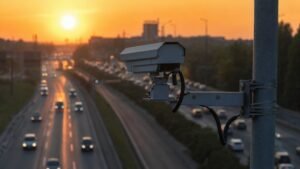
Garrett Langley, the CEO of Flock Safety, wants Americans to “compromise” on privacy. That’s the actual word he used. Compromise. As if privacy is a used car and we’re haggling over the price, and he’s the one holding the keys to a nationwide network of license plate readers.
Wait, Who’s Asking Who to Compromise Here?
Let’s back up for a second, because the framing here is doing a lot of work. Flock Safety builds automated license plate reader cameras – the kind that sit on poles at intersections, in HOA neighborhoods, outside gas stations – and they’ve quietly become one of the largest private surveillance networks in the country. We’re talking thousands of communities, millions of plates scanned daily, data shared across police departments in ways most residents have zero clue about.
And now, amid what the company itself is calling “major backlash,” the guy running the show is basically asking the public to meet him halfway. Not the other way around. Not “we’ll dial back data retention” or “we’ll be transparent about who gets access.” No, it’s Americans who need to bend a little. I don’t know about you, but that’s a pretty rich ask from a company whose entire business model depends on watching you drive to the grocery store.
The Backlash Wasn’t Random
This didn’t come out of nowhere either. Reporting has piled up over the past year or so showing Flock’s cameras getting used in ways that go way beyond “catching stolen cars,” which is the pitch they give to city councils. There’ve been cases of local agencies running searches tied to immigration enforcement, cops using the network for personal reasons that have nothing to do with public safety, and data-sharing agreements that stretch across state lines in ways almost nobody outside a few transparency nerds actually understood until reporters started digging.
So yeah, when the backlash hits, and it’s hitting hard enough that the CEO is out there doing damage control interviews, it’s not because people suddenly discovered cameras exist. It’s because the gap between “we’re stopping car thieves” and “we’re building a surveillance dragnet that outlives any single use case” finally became too obvious to ignore.
What Does “Compromise” Even Mean Here?
Here’s the thing that bugs me the most. When a tech CEO says the public needs to compromise on privacy, what they usually mean is: keep using our product, just feel a little worse about it. It’s not really a negotiation. There’s no table where regular people get to sit down with Flock and hash out data retention limits or oversight rules. The compromise is one-directional. We give up the privacy, they keep the revenue.
And look, I get the pitch on the surface. Nobody wants their car stolen. Nobody’s out here rooting for hit-and-run drivers to get away clean. Public safety is a real thing, and cameras genuinely do help solve some crimes. I’m not going to pretend otherwise, that would be dishonest. But “this tool sometimes helps” isn’t the same as “therefore you should accept unlimited scope creep with basically no guardrails,” which is functionally what’s happened in a lot of these towns.
“Privacy in exchange for safety is a fine trade when it’s actually a trade. It stops being one when the terms keep changing after you’ve already signed.”
The Part Nobody’s Talking About Enough
What’s interesting here, and kind of gets buried in all the “surveillance bad” headlines, is how these systems actually get adopted. It’s rarely a big public vote. It’s usually a city council meeting on a Tuesday night that maybe a dozen residents attend, a pitch from a Flock sales rep about reducing crime stats, and a contract that gets signed before most of the town even knows the cameras are going up. By the time people notice, the network’s already live and the data’s already flowing to who knows how many other agencies through Flock’s search-sharing features.
That’s not really “the public compromising.” That’s the public finding out after the fact. There’s a difference, and I think Langley’s comments kind of gloss right over it. If you want people to genuinely compromise on something, you ask them before you build the thing, not after they’ve caught you sharing plate data with agencies three states away.
Money Talks, Obviously
I’d also be lying if I said the financial angle wasn’t relevant. Flock’s been valued at billions of dollars. Billions. This isn’t some scrappy public safety nonprofit doing its best with limited resources, it’s a well-funded company with investors who want growth, and growth means more cameras, more cities, more data flowing through the pipes. Asking the public to “compromise” conveniently lines up with what keeps that growth curve pointed up and to the right. I’m not saying that’s the only motivation, but come on, it’s definitely in the mix.
What This Actually Means
Here’s my honest read on all this. Companies that build surveillance infrastructure love the word “balance” because it sounds reasonable, and it sounds like both sides are giving something up equally. But in practice, the balance almost always tips toward whoever’s collecting the data, because they’re the ones who get to decide how it’s used, who it’s shared with, and how long it sticks around. The public just gets asked to trust that it’ll be fine.
Maybe some cities really do need this technology to deal with real crime problems, I’m not going to pretend that’s zero. But if Flock wants the public to actually compromise on privacy, that has to come with something concrete in return, real transparency, real limits on data sharing, real oversight that isn’t just a company blog post. Otherwise it’s not a compromise at all. It’s just a company hoping the backlash dies down before anyone changes the rules.
We’ll see which one it turns out to be. Given how this industry’s moved so far, I wouldn’t bet on the transparency option.