
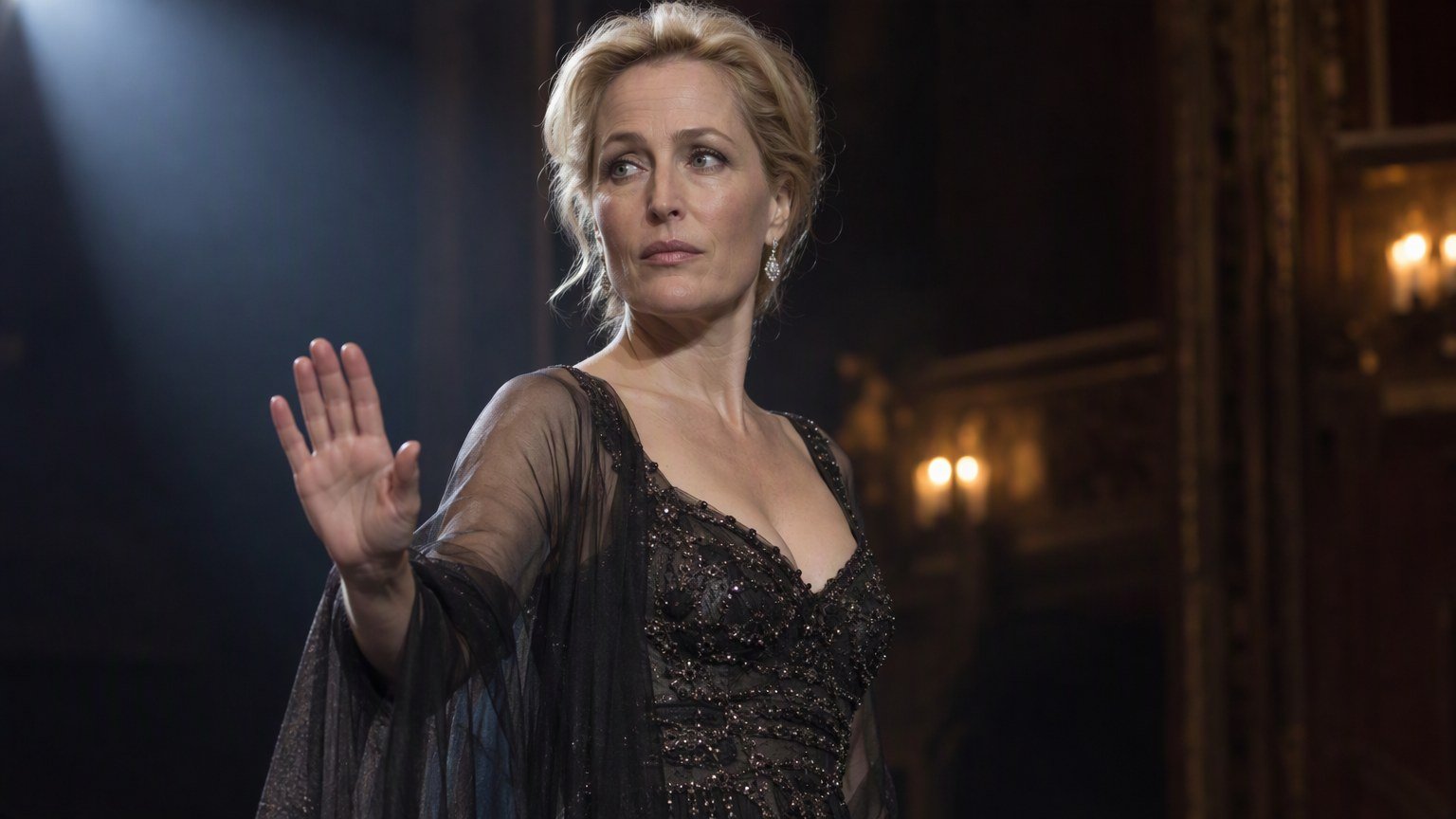
Gillian Anderson just told her most devoted fans to stop sitting in the front row of her West End show. And honestly? The internet doesn’t know what to do with that.
Gillian Anderson just told her most devoted fans to stop sitting in the front row of her West End show. And honestly? The internet doesn’t know what to do with that.
When Your Biggest Fans Become Your Biggest Problem
Here’s what went down: Anderson’s doing “Who’s Afraid of Virginia Woolf?” at London’s Soho Place theater, and apparently there’s a group of superfans – women she’s known for over 20 years, mind you – who’ve been coming back again and again. We’re talking 20 times. Twenty. And they keep parking themselves right in the front row.
A video surfaced showing Anderson outside the theater, signing stuff for fans, when she straight-up tells this group: “You guys cannot sit in the front row.” The fans apologize, they clearly know they’ve been doing something, and one of them tries to explain how much the performance moved them. How they cried. Which, look, is probably true – Anderson’s playing Martha, this absolutely devastating role about a woman trapped in a miserable marriage.
But Anderson wasn’t having it. “I do not care; you cannot sit in the front row. It’s so distracting.” Then she kind of laughs – you can hear it in her voice, that mix of affection and genuine frustration – and says, “You can’t come 20 times and sit in the front row; it’ll drive me mad.”
And that’s where things got messy.
The Fan Entitlement Debate Fires Up Again
Social media did what social media does best: split right down the middle. Half the people were like, yeah, that’s completely reasonable – performers need to focus, front row seats are literally in their eyeline, it’s basic theater etiquette. The other half? They went with the “ungrateful celebrity” angle. These fans paid money (probably a lot of it, 20 times over), they’re supporting her work, how dare she complain about people who love her that much.
The thing is, both sides kind of have a point. But also? Both sides are missing something.
Anderson came back on Sunday with a statement trying to clarify things. She emphasized that these are women she’s known for two decades – this isn’t her snapping at random fans. “We’re thrilled to be doing” the show, she started saying, and the statement cuts off there in what we’ve got, but the message was clear enough: context matters.
What It’s Actually Like Up There
I mean, think about it for a second. You’re on stage doing one of the most emotionally brutal plays in American theater. Edward Albee wrote “Virginia Woolf” to destroy you – it’s two and a half hours of raw, screaming, soul-crushing marital warfare. And you’re trying to disappear into Martha, to make people believe you’re this woman falling apart in real time. Anderson's not alone in defending intense performance choices – Jeremy Strong Won't Apologize for His Method Acting either, even when colleagues find it uncomfortable.
Now imagine that every single time you look out into the audience, you see the same faces. The same women. In the same seats. Night after night after night. You probably start recognizing their reactions. You know when they’re about to cry because you’ve seen them cry at that exact moment fifteen times before. You’re not performing for an audience anymore – you’re performing for your friends, basically, except they’re not quite friends because there’s still that performer-fan dynamic, and the whole thing becomes this weird meta-theater experience that you didn’t sign up for.
“You can’t come 20 times and sit in the front row; it’ll drive me mad.”
The Unspoken Rules of Fandom
Here’s what’s interesting about this whole situation – Anderson and these fans clearly have a relationship. Twenty years of history. She knows them, they know her, there’s obviously mutual affection there. But Anderson still had to set a boundary, and she had to do it in a way that went semi-public because apparently the private conversations weren’t working.
And that’s the part that makes me uncomfortable with the “ungrateful celebrity” takes. These fans knew. You can hear it in the video – “I’m sorry,” “I know.” They knew they were being distracting. They kept doing it anyway.
That’s not love, that’s entitlement. Even well-meaning, affectionate, been-around-forever entitlement is still entitlement.
There’s this thing that happens with superfans sometimes where the relationship gets inverted. Instead of the fan adjusting their behavior to support the artist’s work, the expectation becomes that the artist should just accept whatever the fan wants to do because it comes from a place of love. But love without boundaries isn’t actually respectful. It’s just… a lot.
Where This Fits in the Bigger Picture
Anderson’s not the first person to call out audience behavior recently, and she won’t be the last. We’ve had a weird few years where people seem to have forgotten (or maybe never learned?) how to act in shared public spaces. Theaters, movies, concerts – everywhere you go, there’s someone filming the whole thing on their phone, talking during quiet moments, treating the experience like it’s their personal living room.
Part of it is probably the pandemic. We got used to consuming entertainment alone, on our couches, with full control over everything. Pause whenever we want, rewind, check our phones, whatever. Coming back to live performance means remembering that you’re part of something bigger, and your individual desires don’t always take priority.
But there’s also this broader cultural thing happening where fans feel like their emotional investment in someone’s work entitles them to access, to proximity, to special treatment. And I get it – when something moves you that deeply, when a performance makes you cry 20 times, you want to be close to it. You want the artist to know what they mean to you. That impulse to insert yourself into a friend's performance moment played out recently when Taylor Swift Just Crashed Dakota Johnson's SNL Monologue – though at least that was scripted.
The problem is that artists are people trying to do their jobs. And sometimes your presence, no matter how loving or supportive, makes their job harder.
What This Actually Means
Look, I don’t think Anderson was wrong here. Not even a little bit. She tried to set a boundary with people she’s known for years, people she clearly cares about, and she had to be firm because they weren’t respecting it. That’s not ungrateful. That’s just being a professional who needs to do her work without feeling like she’s performing in someone’s living room.
But I also don’t think these fans are monsters or anything. They love her work, they want to support it, they probably thought showing up over and over was the ultimate compliment. They just didn’t realize – or didn’t want to realize – that impact matters more than intent.
Maybe the real lesson here is that fandom, at its best, means knowing when to step back. Sometimes the most supportive thing you can do is give an artist space to work without watching their every move. Sit in the back. Come five times instead of twenty. Let them forget you’re there so they can disappear into the performance.
Because at the end of the day, that’s what you came for, right? The performance. Not the relationship. Not the recognition. Just the work.
At least, that’s what it should be.