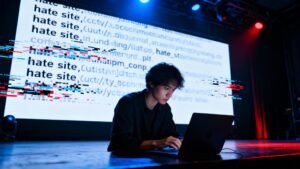
Alright, so here’s the thing. You ever notice how every time there’s a huge scandal brewing with one of these tech giants, especially TikTok, the first thing out of their mouth is always, always some version of “Oops, our bad! Total glitch! Nothing to see here, folks!” It’s like a broken record, honestly. And it’s happening again, this time with users trying to upload anything even remotely critical of ICE – you know, Immigration and Customs Enforcement.
So, What’s the Deal with TikTok and ICE, Anyway?
Look, the internet’s buzzing right now, and not in a good way. People are reporting – and I mean lots of people, not just a handful of disgruntled randos – that their videos criticizing ICE are getting blocked. Not just taken down after the fact, mind you, but actually failing to upload in the first place. Like, the platform just says “nope, not today, pal.”
And what’s TikTok’s response to all this? Oh, you guessed it! “It’s a glitch!” A technical error. A bug in the system. Just some rogue lines of code decided, on their own accord, to target content specifically about immigration enforcement. Yeah, sure. And I’ve got a bridge in Brooklyn to sell you. This isn’t some random filter gone wild; this smells suspiciously like a deliberate targeting of politically charged content.
I mean, come on. We’re talking about a platform that’s already under a microscope for its content moderation practices. You’d think they’d be extra, extra careful about anything that even looks like censorship, especially when it involves government agencies. But here we are. Users are furious, and frankly, who can blame ’em? You spend time crafting a message, you try to share your perspective, and poof – it vanishes into the digital ether. Or, worse, it never even makes it there.
Not Their First Rodeo, Is It?
This isn’t TikTok’s first dance with controversy over what they allow or don’t allow. Not by a long shot. Remember all the kerfuffle about content related to the Uyghurs in Xinjiang? Or the Hong Kong protests? Yeah, those memories are still pretty fresh for a lot of us. The pattern kinda goes like this: accusations of censorship, TikTok denies, says it’s an error, then maybe-eventually apologizes or makes some vague promise to do better. Rinse and repeat.
And every single time, it’s always on topics that are… let’s just say, sensitive to certain powerful entities. Funny how those “glitches” never seem to accidentally boost content critical of, I don’t know, kitten videos or celebrity gossip. It’s always the stuff that actually matters, the stuff that makes people think, the stuff that challenges the status quo. Call me cynical, but I’ve seen this play out too many times over my fifteen years in this game to just shrug and say, “Oh, a glitch!”
A Glitch? Or a Feature?
Here’s what really grinds my gears about the “glitch” excuse: it’s so darn convenient. It allows them to sidestep any actual responsibility. “Oh, we didn’t mean to silence dissent, it was just the computers being goofy!” It absolves them of having to explain why their algorithms or human moderators might have a bias. And that, my friends, is a problem. A really big problem for anyone who cares about free expression, especially online.
Think about it. In an age where social media platforms are basically the new public square, controlling what gets seen and what doesn’t is immense power. When a company, especially one with ties to a foreign government – and we’ll get to that in a sec – decides what political speech is acceptable, we should all be worried. Very worried. Because if they can quietly suppress anti-ICE content today, what’s next? Anti-whatever-they-don’t-like tomorrow?
“It’s not just about ICE. It’s about who gets to control the conversation, and whether platforms are truly neutral or just another gatekeeper with their own agenda.”
The Bytedance Angle and Why It Matters
Alright, let’s talk about the elephant in the room: TikTok’s parent company, Bytedance. They’re based in China, right? And China, as we all know, has a slightly… different approach to free speech than, say, the U.S. government. (That’s putting it mildly, by the way.) This isn’t some conspiracy theory; it’s a known geopolitical reality. Bytedance operates under the laws and influences of the Chinese government. That’s just a fact.
So, when content critical of an immigration enforcement agency in the U.S. suddenly becomes “un-uploadable” on a platform owned by a Chinese company, my alarm bells aren’t just ringing; they’re doing a full-on heavy metal concert. Is it a direct order from Beijing? Probably not, not explicitly. But is there an underlying pressure? An unspoken understanding of what kind of content might cause trouble for the company globally? You bet your bottom dollar there is.
It’s a subtle thing, sometimes. It’s not always a memo saying “ban this specific hashtag.” It’s more about building systems, training algorithms, and instilling a corporate culture that errs on the side of caution – or, let’s be blunt, censorship – when it comes to politically sensitive topics. Especially topics that might cause a headache with any government, anywhere. And let’s face it, U.S. immigration policies are a hot-button issue, both domestically and internationally. It’s an easy target for a platform trying to keep a low profile on controversial stuff.
What This Actually Means
Here’s my honest take: This isn’t a glitch. Not really. It’s either a deliberate policy decision, or it’s a “glitch” born out of a systemic bias built into their moderation tools. Either way, it means that a powerful platform is choosing what voices get heard and what voices get silenced. And when those voices are speaking out against government actions, that’s a chilling precedent.
For the average TikTok user, it means you can’t trust the platform to be a truly open space for discussion on critical issues. It means your “free speech” on TikTok comes with invisible strings attached. For activists and advocates, it means they have to work even harder, find other avenues, and frankly, it’s exhausting. It really is.
So, the next time TikTok trots out the old “glitch” excuse, don’t just nod along. Ask questions. Push back. Because if we don’t, then these “glitches” will just become accepted practice, slowly but surely eroding our ability to speak truth to power in the very spaces that claim to connect us all. And that, my friends, is a future I definitely don’t want to live in.