




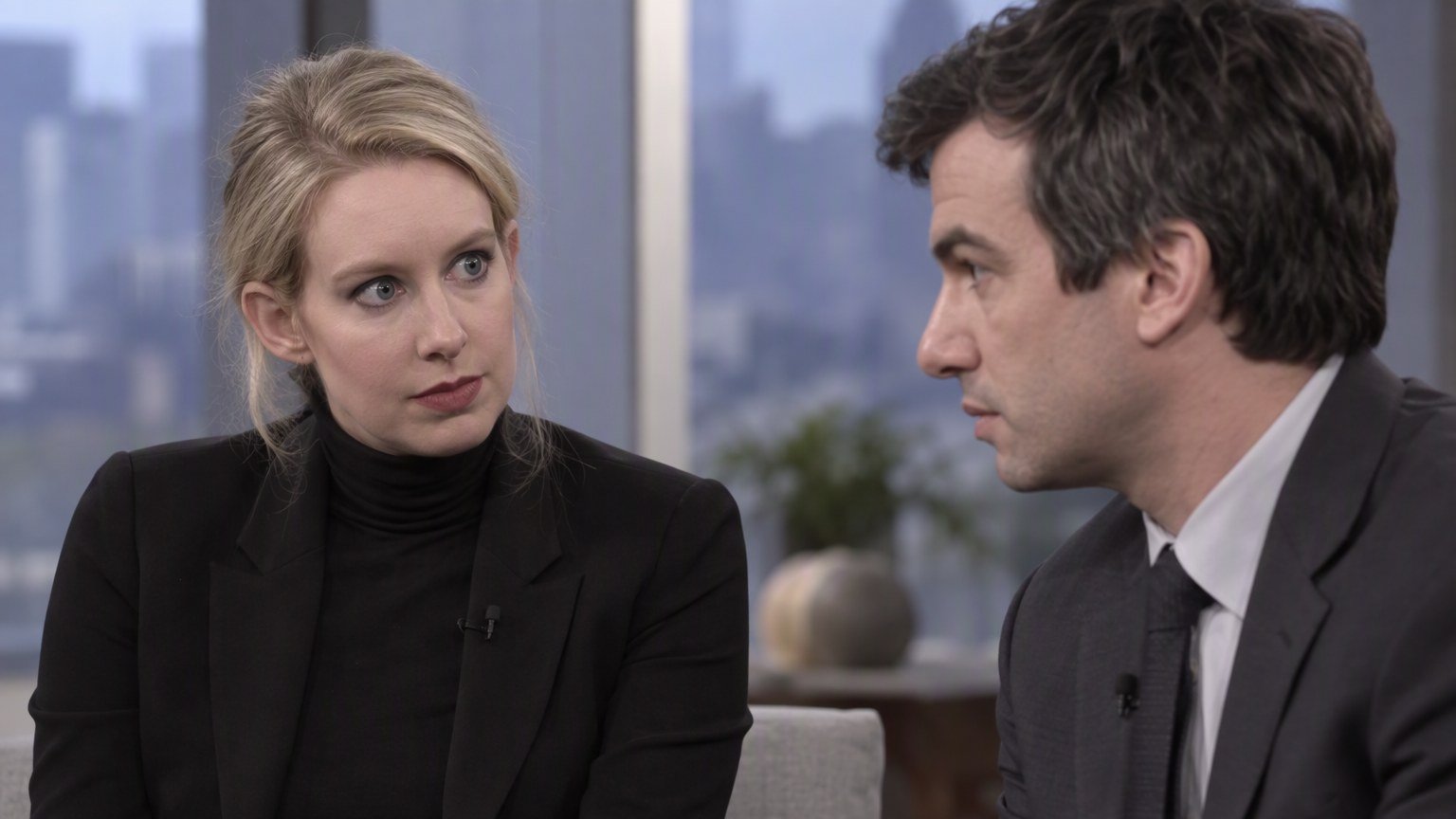
Look, I’ve watched a lot of uncomfortable television in my day. The Office made cringe comedy an art form. Nathan Fielder basically built his career on making people squirm. But watching Elizabeth Holmes try to flirt with Nathan Fielder by staring directly into his soul? That’s a different kind…
Look, I’ve watched a lot of uncomfortable television in my day. The Office made cringe comedy an art form. Nathan Fielder basically built his career on making people squirm. But watching Elizabeth Holmes try to flirt with Nathan Fielder by staring directly into his soul? That’s a different kind of uncomfortable.
The Eye Contact Thing Was Already Weird
Here’s what you need to know – this footage is from 2022, shot during the 34 days before Holmes reported to prison for an 11-year sentence. She’d already been convicted of defrauding Theranos investors. The fake blood-testing company had collapsed. Her deep voice thing had been exposed. The black turtlenecks had become a punchline. And somehow, in the middle of all this, someone thought it’d be a good idea to have Nathan Fielder interview her for a film called “You Can See Everything.”
The irony of that title, by the way? Not lost on anyone.

So Fielder asks her how she flirted with Billy Evans – that’s her husband now, father of her two kids, the guy she met at a San Francisco house party back in October 2017 when everything was already falling apart. Her answer? “Holding deep eye contact for long periods of time.”
And then she demonstrates. On Fielder. Who looks like he wants to crawl out of his own skin.
When Flirting Becomes a Hostage Situation
The thing is, Holmes’ stare has been documented for years now. People have written entire think pieces about how rarely she blinks. Henry Kissinger – yeah, that Henry Kissinger – once called her “ethereal.” John Carreyrou spent years investigating her and probably got stared down more times than he could count.
But there’s something different about watching her deploy this technique as an actual flirting strategy. Evans apparently fell for it (“I fell in love in that first conversation,” he says in the film). Good for him, I guess? Love is weird and we don’t get to choose what works for us.
But Fielder? The man who’s made a living out of creating the most awkward situations imaginable and staying completely deadpan through all of it? Even he looks visibly uncomfortable. That’s saying something.
The Audacity of It All
What gets me – and I mean really gets me – is the timing. This woman is 34 days away from federal prison. She’s been convicted of fraud. Her company’s collapse cost investors hundreds of millions of dollars and potentially put patients at risk with faulty blood tests. And she’s sitting there, on camera, explaining her flirting technique like she’s giving relationship advice on a morning talk show.
The disconnect is kind of staggering.
Why Does This Even Matter?
Here’s the thing – the Holmes case has always been about more than just fraud. It’s been about belief, about charisma, about how someone convinced some of the smartest, most powerful people in the world to hand over their money and reputations based on… what, exactly? Technology that didn’t work? A vision that couldn’t be realized? The same uncomfortable questions about hype, belief, and accountability echo through “Why $17B Wasn’t Enough: AI Doomers Turn on Anthropic.”
And the eye contact thing is part of that. It’s a technique. A tool. Whether it’s conscious or not (and honestly, describing it out loud to Fielder suggests it’s pretty damn conscious), it’s part of how she operated.
“I fell in love in that first conversation” – Billy Evans, describing meeting Elizabeth Holmes
Evans seems genuinely in love with her. They got married, had two kids. He’s stood by her through the trial and the sentencing. That’s real, I’m not questioning that. But watching her explain that the foundation of their connection was a flirting technique involving prolonged eye contact? It’s hard not to see everything through the lens of manipulation at that point.
Maybe that’s unfair. Maybe it’s just how she connects with people. Maybe some people really do fall in love by staring at each other without blinking like they’re in some kind of extremely intense staring contest.
Nathan Fielder, Professional Awkward Person, Meets His Match
The comedy here – if you can call it that – is that Fielder has built his entire career on being the most uncomfortable person in the room on purpose. “Nathan For You” ran for four seasons of him pitching increasingly insane business ideas to real small business owners with complete sincerity. “The Rehearsal” took that to even weirder places.
This guy knows awkward. He’s a black belt in awkward. And Holmes made him squirm with eye contact alone.
Part of me wonders if she knew exactly what she was doing. If the whole thing was some kind of weird power play. Here’s this comedian who specializes in making other people uncomfortable, and she’s going to flip the script on him. Or maybe she genuinely thought she was being charming? It’s honestly hard to tell with Holmes, which has kind of been the problem all along.
What This Actually Tells Us
I’ve been thinking about this whole thing more than I probably should. And what keeps coming back to me is this: even facing prison, even after everything had fallen apart, Holmes was still performing. Still using the same techniques. Still trying to control the narrative and the interaction. “The Real Story Behind Bela Bajaria’s Netflix Exit” offers a related look at how ambitious personalities are packaged and performed for an audience.
That’s either incredibly sad or deeply unsettling. Probably both.
The eye contact thing works on some people – Evans is proof of that. It made Kissinger think she was ethereal. It probably helped her raise all that money and build all those partnerships. But when you watch it fail, when you watch someone like Fielder clearly want out of that interaction, you see it for what it really is. Just another technique. Another tool in the kit.
And the fact that she’s willing to explain it, demonstrate it, turn it into content for a documentary weeks before going to federal prison? That tells you everything about how she sees herself and her story. She’s still the protagonist. Still in control. Still flirting with the camera, basically, even when the person behind it looks like he’s seriously regretting his career choices.
The film is called “You Can See Everything,” but I’m not sure we really can. We see what Holmes is willing to show us, performed exactly how she wants to perform it. The stare included.