
There’s about 1.4 million kilometers of fiber optic cable lying on the ocean floor right now, quietly carrying roughly 99% of all intercontinental internet traffic. And here’s the thing – we’ve basically spent the last few decades treating these cables like they’re indestructible, which, spoiler alert, they’re not.
Most people assume the internet travels through satellites. I mean, that makes sense, right? Satellites feel futuristic and high-tech. But nope. Your video calls, your Netflix binges, your doomscrolling at 2 AM – it’s all bouncing through cables that snake along the ocean floor like some kind of massive, planet-spanning nervous system. And that system is starting to show some serious cracks.
The weird part? We don’t really talk about this. It’s one of those critical infrastructure things that everyone sort of knows exists but nobody thinks about until something goes horribly wrong.
Why Cables Instead of Satellites Anyway?
Okay, so satellites sound way cooler. They’re floating in space! They’re modern! Except they’re also slow (relatively speaking) and stupidly expensive to maintain. Submarine cables, on the other hand, can carry about 100 times more data than satellites, with way less latency. Physics is a harsh mistress – that signal has to travel a lot farther when it’s bouncing off something in orbit.
The first transatlantic cable went live back in 1858, which is kind of mind-blowing when you think about it. Queen Victoria sent a message to President Buchanan, and it took something like 16 hours to transmit. The cable died after a few weeks, but still. The ambition was there.
Fast forward to today, and we’ve got cables that can transmit 400 terabits per second. That’s… I mean, that’s an incomprehensible amount of data. But here’s where it gets messy – these modern cables are getting damaged at an alarming rate, and the threats are coming from places we didn’t really anticipate.
The Usual Suspects (Ships and Anchors)
Ship anchors and fishing trawlers have always been the main culprits. Some poor fishing boat drags its equipment across the seabed, snags a cable, and boom – internet disruption for an entire region. It happens more often than you’d think, actually. The cable companies have tried burying the cables deeper in shallow waters, but that only goes so far.
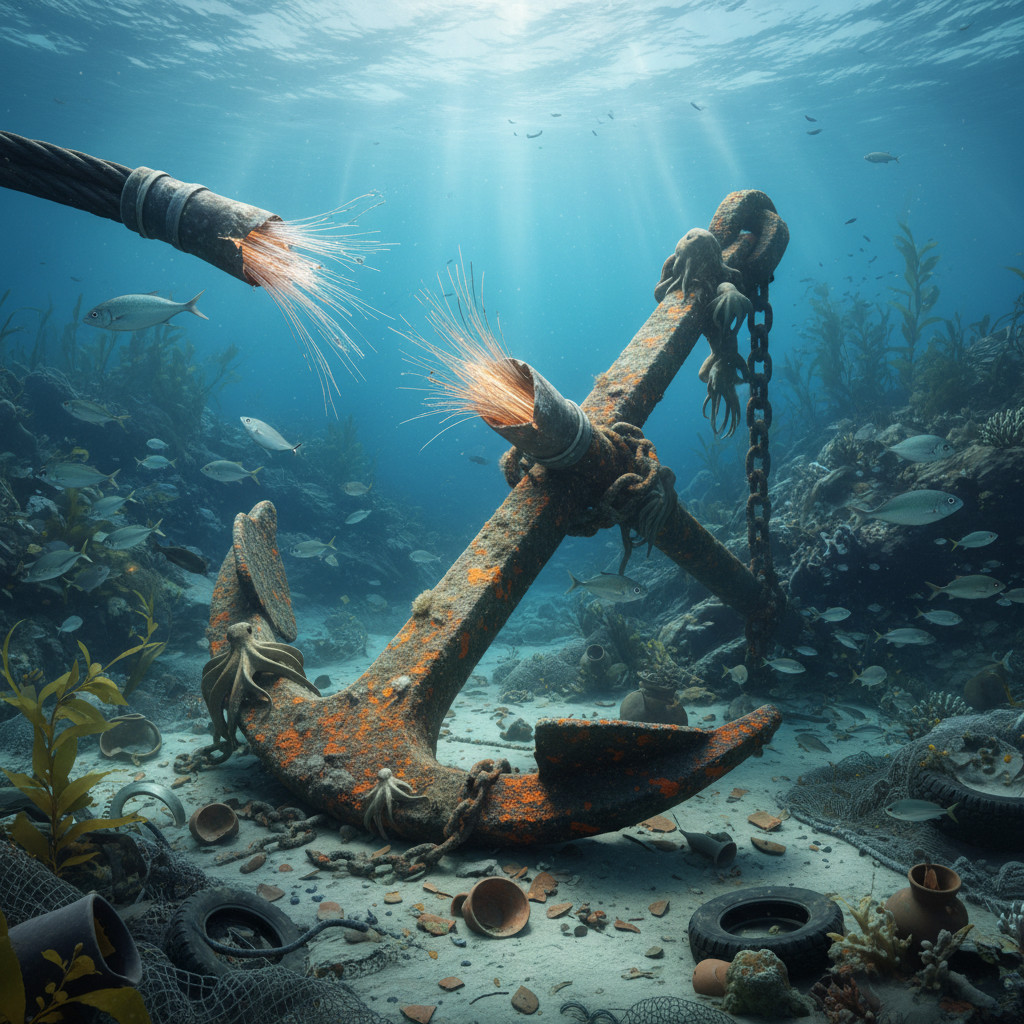
Here’s a fun fact that’s not really fun at all – in 2017, a ship’s anchor cut off internet access to an entire country. Mauritania went dark because one anchor hit one cable at just the wrong spot. The whole country. Just like that.
The New Problems We Didn’t See Coming
Climate change is doing a number on these cables in ways that are honestly pretty creative, if you can call environmental destruction creative. Stronger storms mean more debris being churned up from the ocean floor. Rising sea levels are shifting underwater geography. And warmer ocean temperatures? They’re literally changing where fish swim, which means fishing activities are happening in new areas where cables weren’t protected because, well, nobody fished there before.
There’s also the whole geopolitical angle, which feels very 2025. Countries are suddenly very interested in where these cables run and who controls them. Russia’s been accused of surveying cable routes with submarines. China’s building its own cable infrastructure at a breakneck pace. It’s like the Cold War, but underwater and made of glass fiber.
What Happens When a Cable Actually Breaks?
So you’re probably wondering – what’s the actual fallout here? Well, it depends. We’ve got redundancy built into the system (thank god), which means most cable cuts don’t cause complete blackouts. Traffic just gets rerouted through other cables. You might notice your connection is slower, or you might not notice anything at all.
But – and this is a big but – that redundancy only works if we’re talking about one or two cables failing. If something takes out multiple cables in a region, or if a major cable hub gets compromised, things get real dicey real fast.
“The internet feels infinite and ethereal, but it’s actually shockingly physical and surprisingly fragile.”
Case in point: In 2008, two separate cable failures in the Mediterranean knocked out internet access for millions of people across the Middle East and India. Egypt, Saudi Arabia, India – all experiencing massive slowdowns. It took weeks to fully repair.
The Repair Process Is Basically Naval Surgery
Fixing these cables is not a quick job. First, you’ve got to find the break, which involves sending down underwater vehicles to survey potentially hundreds of miles of cable. Then you need a specialized repair ship – and there aren’t that many of them in the world, maybe 50 or 60 total. These ships have to haul up the broken cable (which can be several miles deep), splice in a new section, and lower it all back down.
The whole process can take weeks. In deep water, it’s even more complicated. We’re talking cable segments that weigh several tons per kilometer, pressures that would crush most equipment, and repair work that has to be done with robotic precision.
- Average repair time: 10-15 days for a single break, longer if weather doesn’t cooperate
- Cost per repair: Easily runs into millions of dollars, depending on location and depth
- Number of breaks per year: Somewhere around 200 globally, though exact numbers are kind of fuzzy

The Economics Are Getting Weird
Here’s something that doesn’t get enough attention – the cable-laying industry is going through some wild changes. It used to be that telecom companies and international consortiums funded these projects. Now? Big tech is taking over.
Google, Facebook (sorry, Meta), Microsoft, Amazon – they’re either building their own cables or buying up massive amounts of capacity. Makes sense when you think about it. These companies are responsible for a huge chunk of internet traffic. Why pay someone else for bandwidth when you can just… own the actual cables?
Google alone has invested in something like 19 different submarine cable projects. They’ve got part ownership in cables crossing the Pacific, the Atlantic, even one connecting the US to Argentina. It’s a level of infrastructure control that would’ve seemed crazy 20 years ago.
What This Means for the Rest of Us
On one hand, more investment in cables is probably good? Better infrastructure, more capacity, faster speeds. On the other hand, it’s kind of unsettling that so much of the internet’s physical backbone is increasingly controlled by a handful of American tech giants. What happens if geopolitical tensions rise and countries start questioning whether they should rely on cables owned by foreign corporations?
Some countries are already thinking about this. Brazil’s been pushing for cables that don’t route through the US. The EU is talking about “digital sovereignty.” It’s messy, and it’s only going to get messier.
So What Happens Next?
The honest answer is – we probably keep limping along until something forces a major reckoning. That’s how infrastructure works most of the time, right? Fix it when it breaks, upgrade it when you absolutely have to, hope nothing catastrophic happens in the meantime.
But there are some interesting developments happening. New cable designs that are more resistant to shark bites (yes, that’s a real problem – sharks apparently love chewing on cables). Better monitoring systems that can detect damage faster. Some researchers are even working on self-healing cables, though that feels pretty sci-fi at the moment.
The real question is whether we’re willing to treat this infrastructure with the seriousness it deserves. Because right now, we’re one major disruption away from remembering just how fragile our “wireless” world actually is. Kind of ironic, isn’t it? The cloud isn’t really in the clouds at all. It’s in the ocean, wrapped in protective coating, sitting on the seafloor, hoping a fishing trawler doesn’t come along and ruin everything.
Maybe next time your internet cuts out, take a second to think about those cables. They’re down there, doing their thing, keeping the whole digital world spinning. At least until the next shark gets hungry.