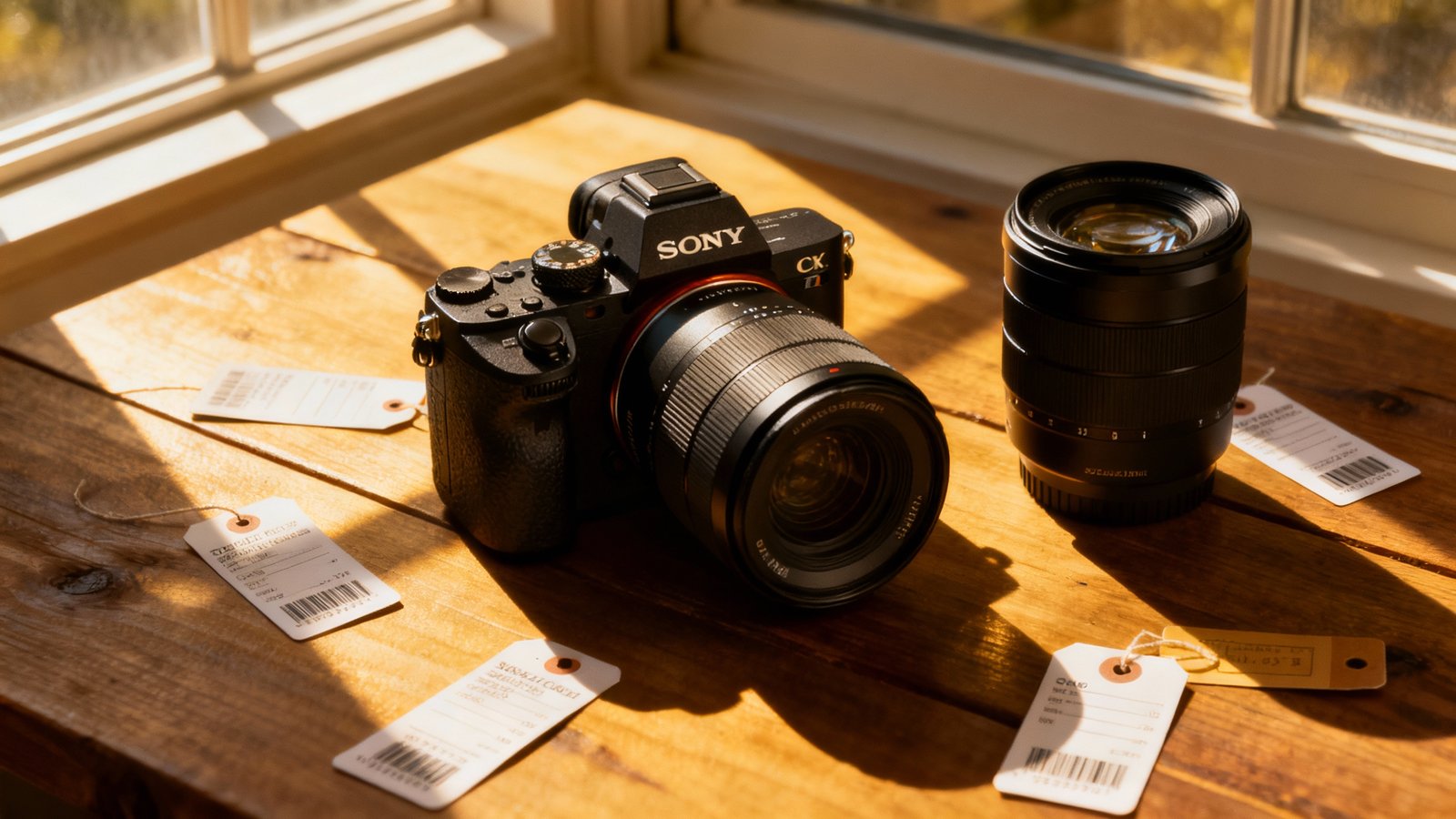
Look, I’m not going to sugarcoat this – Sony’s pro cameras don’t exactly come cheap. We’re talking about the kind of gear that makes your credit card weep and your wallet file for a restraining order. But here’s where things get interesting. Both the A7R IV and the brand-new A7R V just dropped to prices that, honestly, I had to double-check because they seemed too good to be real.
The A7R IV is sitting at $2,298 right now (down from its usual $2,798), and the A7R V – which only launched last year, mind you – is going for $3,398 instead of its eye-watering $3,898 price tag. Yeah, these are still expensive cameras. But for anyone who’s been watching these models like a hawk, waiting for the right moment to pull the trigger, this is kind of a big deal.
And before you ask – yes, these are all-time lows. Not “oh we knocked off twenty bucks and called it a sale” territory. We’re talking real, substantial price cuts on cameras that professional photographers actually use to pay their mortgages.
The A7R IV Is Still a Beast (Even If It’s Getting Some Gray Hair)
Here’s the thing about the A7R IV – it came out in 2019, which in camera years is basically ancient history. But you know what? This thing still absolutely rips. The 61-megapixel full-frame sensor hasn’t suddenly become obsolete just because newer models exist. If anything, the fact that it’s held its value so well until now tells you everything you need to know about its staying power.
What Makes It Worth Your Money
I’ve seen photographers shoot magazine covers, commercial work, and massive landscape prints with this camera. It handles all of it without breaking a sweat. The autofocus system locks onto subjects faster than you can say “manual focus is dead,” and the in-body stabilization means you can hand-hold shots that would’ve required a tripod just a few years ago.

The 61-megapixel resolution is actually sort of insane when you think about it. We’re talking about files so large you could print them on the side of a building. Well, maybe not literally, but you get the idea. You’ve got serious cropping flexibility – like, you can crop to 50% and still have a massive, print-ready image. For wildlife photographers or anyone who can’t always get close enough to their subject, that’s basically magic.
- 10fps continuous shooting: Not the fastest out there, but more than enough for most situations that aren’t Olympic-level sports
- 567 phase-detection AF points: Covers about 74% of the frame, which means the camera actually sees what you’re trying to shoot
- Real-time Eye AF: Works for humans and animals, because your dog deserves sharp portraits too
- 5-axis stabilization: Rated for 5.5 stops of compensation, which is the difference between a sharp shot and digital garbage
The Reality Check
Now, let’s be honest – it’s not perfect. The battery life is kind of mediocre (you’ll want spares), and those massive RAW files will eat your hard drive space faster than you can say “I should’ve bought more storage.” The menu system is also classic Sony, which is to say it’s organized like someone dumped all the settings into a blender and hit “chaos mode.”
But at $2,298? Those quirks become a lot more tolerable.
The A7R V: When New Money Meets Real Discounts
The A7R V is basically Sony saying “yeah, we know the IV was good, but watch this.” It launched in late 2022 with a price tag that made even professional photographers wince a little. But this Black Friday deal knocks $500 off, which is – and I can’t stress this enough – actually unprecedented for a camera this new and this capable.
What You’re Actually Paying For
This is where Sony threw everything at the wall to see what would stick. Spoiler alert: pretty much everything stuck. The sensor got bumped to 61 megapixels (same as the IV, interestingly enough), but the processing power went absolutely bonkers. We’re talking about an AI-powered autofocus system that can recognize and track specific subjects like cars, trains, planes, and insects. Insects! Because apparently, macro photographers needed their cameras to be smarter than the bugs they’re shooting.
“The A7R V’s autofocus doesn’t just find your subject – it predicts where they’re going and adjusts accordingly. It’s basically the camera equivalent of reading someone’s mind.”

The viewfinder is a massive upgrade – a 9.44-million-dot OLED that’s so sharp it’s almost unsettling. And they finally gave us a fully articulating screen, which might seem like a small thing until you’re trying to shoot at weird angles and realize you can actually see what you’re composing. Revolutionary? Maybe not. Extremely useful? Absolutely.
- 693 phase-detection points: Yeah, they added 126 more points because why not
- 8-stop in-body stabilization: This is getting into “how is this even possible” territory
- 8K video at 24fps: For when HD just isn’t enough pixels
- Improved weather sealing: Because expensive cameras and rain don’t usually mix well
The “But Actually” Moment
Here’s the kicker – the V is objectively better than the IV in almost every measurable way. Better autofocus, better stabilization, better screen, better everything. But is it $1,100 better? That’s the real question, isn’t it?
If you’re a working professional who needs the absolute best autofocus for unpredictable subjects (think wedding photographers, wildlife shooters, sports coverage), that extra grand might actually be worth it. The AI autofocus alone could be the difference between nailing the shot and missing it entirely. But if you’re shooting mostly controlled environments – studio work, landscapes, architecture – the IV will do basically everything you need for a lot less money.
Who Should Actually Buy These Things
Let’s get real for a second. These aren’t cameras for someone who just wants to take better vacation photos than their iPhone can manage. (Though they’d certainly do that job, albeit in the most expensive way possible.)
The A7R IV makes sense if you’re a professional or serious enthusiast who needs high resolution for commercial work, fine art prints, or stock photography. It’s also solid for anyone transitioning from an older Sony body – the learning curve won’t be too steep since the menu system is similarly Byzantine across the whole lineup.
The A7R V, on the other hand, is kind of the ultimate “I want the best and don’t want to upgrade for five years” choice. It’s future-proof in a way that few cameras manage to be. The AI autofocus and 8K video capability mean it’ll stay relevant even as technology marches forward. Plus, that insane stabilization system means you can shoot in situations that would’ve been impossible without serious rigging just a few years ago.
The Actually Practical Stuff Nobody Talks About
Both cameras use the same battery (the NP-FZ100), which is great if you’re already in the Sony ecosystem. They share the same lens mount (E-mount), obviously, and they’re both weather-sealed enough that you won’t have a panic attack if a few raindrops hit them.
What Else You’ll Need to Budget For
And this is where things get slightly painful – because you can’t just buy the camera body and call it a day. You’ll need lenses (good ones aren’t cheap), memory cards (fast ones that can handle 61-megapixel RAW files definitely aren’t cheap), extra batteries, probably a good strap, maybe a new bag, and oh yeah, approximately seventeen external hard drives for all that data.
Figure on spending at least another $1,000-2,000 on the essentials if you’re starting from scratch. More if you want premium glass. Way more if you get bit by the lens-collecting bug (and trust me, you will).
But here’s the thing – at these prices, you’re getting pro-level gear for what used to be enthusiast-level money. The A7R IV at $2,298 is genuinely competitive with cameras that don’t offer half its resolution or capability. And the V at $3,398, while still a chunk of change, is actually reasonable for what you’re getting.
Are these deals going to last? Probably not beyond Black Friday or Cyber Monday. Sony doesn’t tend to discount their high-end gear this aggressively very often, and when they do, stock tends to evaporate pretty quickly. If you’ve been on the fence about either of these cameras, this is probably the best opportunity you’re going to get for a while. Maybe even the best one we’ll see until the next generation comes out, which could be years away for the V.
Just, you know, maybe check your bank account first. And possibly have a conversation with your significant other. These purchases tend to go over better when everyone’s on board.