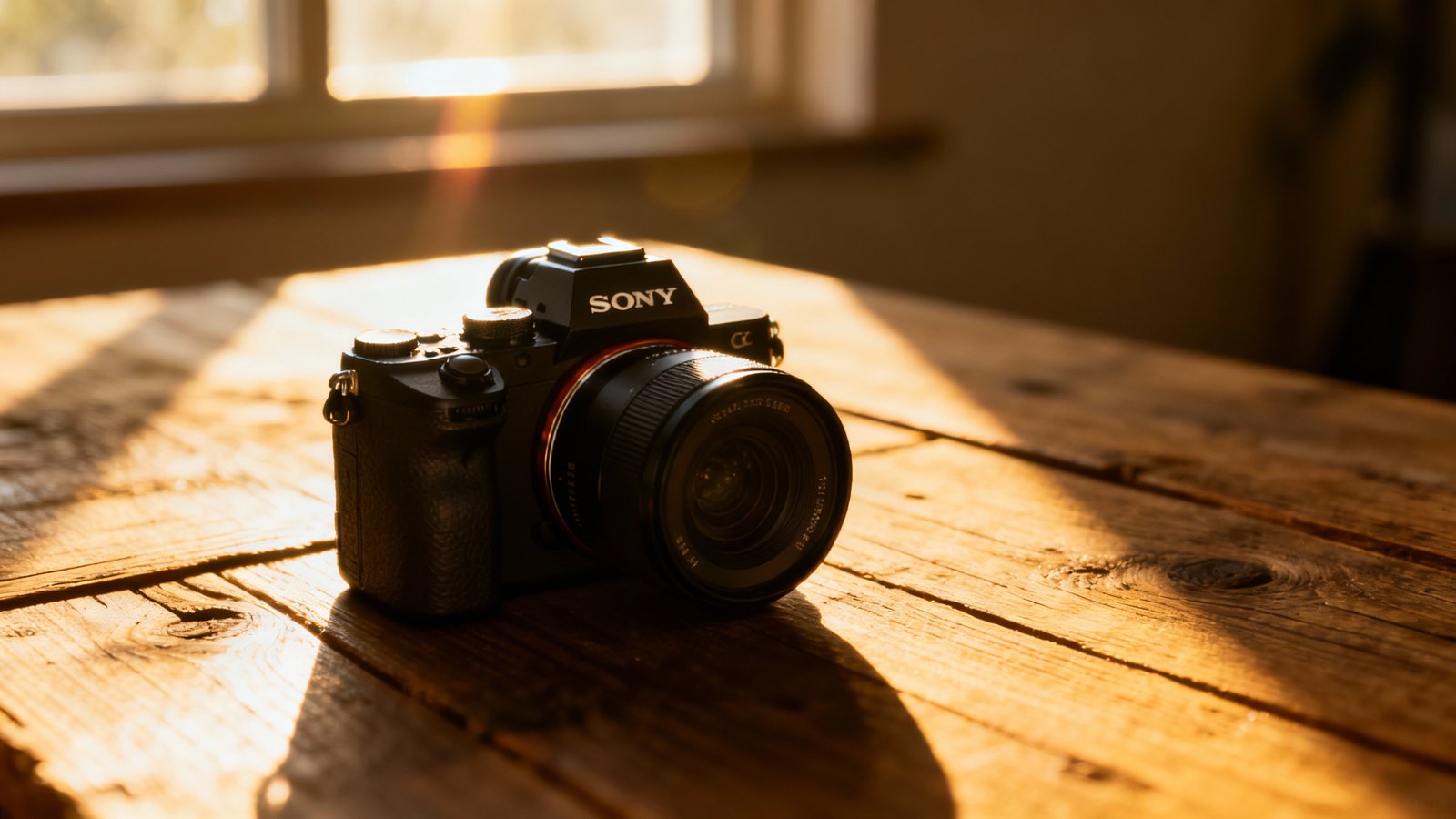
You know that sweet spot in camera lineups where professional features meet non-mortgage pricing? Sony’s been absolutely owning that space with their A7 series, and now they’re about to shake things up again. The A7 V is officially on the horizon, and if the early teasers are anything to go by, this might be the camera that makes a lot of pros reconsider whether they actually need those flagship models.
Sony dropped the teaser at CES 2025, and honestly, the timing couldn’t be more interesting. The mirrorless market has been getting wild lately – everyone’s pushing computational photography, AI autofocus, and video specs that would’ve seemed impossible just a few years ago. The A7 IV has been a workhorse since 2021, which in camera years is basically ancient history.
Here’s the thing though. This isn’t just another incremental update.
What Makes the A7 Line So Special (And Why This Matters)
Let’s back up for a second. The A7 series has always been Sony’s Goldilocks camera – not too expensive like the A1, not too basic like the A7C. It’s the one that working photographers actually buy with their own money, you know? Wedding shooters, event photographers, content creators who need something reliable without selling a kidney.
The A7 IV nailed this formula pretty hard. It brought 33-megapixel stills, solid 4K video, and that Sony autofocus that basically feels like cheating. But it’s been four years. Four years of watching Canon and Nikon roll out new sensors, better video codecs, and AI features that sound like science fiction.
The Midrange Revolution Nobody Talks About
Here’s what’s actually happening in the camera market right now, and it’s kind of fascinating. The gap between midrange and flagship is shrinking fast. Not because flagships are getting worse – they’re getting almost absurdly good – but because the technology is trickling down faster than ever before.

Features that were flagship-only three years ago? They’re standard now. Eye autofocus for animals. Real-time tracking. 10-bit video. In-body stabilization that actually works. The A7 V isn’t just competing with the old A7 IV anymore. It’s competing with smartphones, with Nikon’s Z6 III, with Canon’s R6 Mark II, and honestly, with Sony’s own higher-end models.
What We Actually Know (And What We Can Guess)
Sony’s being pretty tight-lipped about specs, which is typical. But the teaser campaign isn’t exactly subtle. They’re positioning this as a significant leap, not just a refresh. And based on what their other recent cameras have been doing, we can make some educated guesses.
The Sensor Situation
First up – the sensor. The A7 IV’s 33-megapixel sensor has been great, but Sony’s newer sensors in the A7R V and A9 III have some genuinely impressive tech. We’re probably looking at a new sensor design, maybe in that same 33-megapixel range or possibly bumped to somewhere around 40. More megapixels isn’t always better (there, I said it), but modern sensors are handling noise and dynamic range so much better than older high-res ones used to.
There’s also this whole thing about readout speeds. The A9 III has that global shutter that eliminates rolling shutter entirely, but that’s probably not making it into the A7 V – it’s expensive tech. What we might see is a stacked sensor design that gets close enough for most practical purposes.
Video Specs That Actually Matter
Let’s be real – video specs have become this weird arms race where everyone’s trying to out-K each other. The A7 IV did 4K at 60fps, which was fine for 2021. But now? Content creators want 4K 120fps for slow-motion. They want 10-bit 4:2:2 internal recording. They want log profiles that don’t murder their storage drives.
- 4K 120fps: Probably happening – it’s becoming table stakes in this price range
- Better heat management: Please, Sony, the overheating thing is getting old
- Improved codecs: Maybe HEVC, possibly even some of that fancy AI-assisted compression
- Actually usable autofocus in video: The A7 IV was good, but it could get confused in complex scenes

The AI Question Nobody’s Really Answering
Here’s where things get interesting – and a little bit weird. Every camera company is cramming AI into their products now, but what does that actually mean? Sony’s been doing computational photography for years in their smartphones. Their autofocus systems already use machine learning for subject recognition. But are we talking about real AI features, or just marketing buzzwords?
The A7R V has that AI-based autofocus that can recognize specific subjects – not just “person” but “person’s eye” even when they’re moving erratically. It’s genuinely impressive when it works. If the A7 V gets an upgraded version of this, it could be a game-changer for sports and wildlife shooters who can’t quite justify the A1’s price tag.
Features We’re Hoping For (But Might Not Get)
Look, every photographer has their wishlist. Mine includes a flip-out screen that doesn’t feel like it’s going to snap off (the A7 IV’s was kind of flimsy), better ergonomics for those of us with larger hands, and for the love of all that’s holy, a menu system that doesn’t require a PhD to navigate. Sony’s menus have gotten better, but they’re still kind of a nightmare compared to Canon’s interface.
Battery life is another thing. The A7 IV was decent, but “decent” doesn’t cut it when you’re shooting a wedding or a full day event. The Z9 batteries are basically magic – they just keep going. Sony needs to match that.
“The midrange camera market is where the real innovation happens now. Flagship features from two years ago become midrange standard features, and that’s exactly what we’re seeing with the A7 V.”
Why This Actually Matters (Beyond Just Camera Nerds)
Okay, so why should anyone outside the photography world care about another camera release? Because it’s kind of a bellwether for where imaging technology is going. The features that show up in cameras like the A7 V eventually make their way into smartphones, security systems, autonomous vehicles – basically anything with a lens.
Plus, there’s this broader question about the future of dedicated cameras. Smartphones are getting scary good. The iPhone 15 Pro can shoot Log video. The Pixel’s computational photography is borderline supernatural. Every year, someone writes another “cameras are dead” article. And every year, cameras like the A7 series prove there’s still a massive gap between phone cameras and proper imaging systems.
The Price Reality Check
Let’s talk money because that’s kind of the whole point of the A7 line. The A7 IV launched at around $2,500 body-only, which was actually pretty reasonable for what you got. The A7 V will probably land somewhere between $2,500 and $3,000, maybe creeping toward that higher end if Sony’s feeling confident about the feature set.
That’s not cheap by any stretch. But compared to the A1 at $6,500 or the A9 III at $6,000? It starts to look like a bargain. Especially if you’re getting 80-90% of the performance for less than half the price.
The real competition isn’t just other Sony cameras though. Canon’s R6 Mark II is sitting pretty at around $2,500 with genuinely excellent specs. Nikon’s Z6 III brought some serious upgrades. Even Panasonic’s S5 II is making noise in this space. Sony can’t just coast on their autofocus reputation anymore.
What Happens Next
The official announcement is coming soon – probably within the next few months based on Sony’s typical teaser-to-launch timeline. We’ll get actual specs, real-world testing, and inevitably, lots of YouTube videos of people pixel-peeping and arguing about whether the improvement justifies upgrading.
For current A7 IV owners, the calculus is tricky. That camera is still excellent, and unless you’re really pushing its limits, the V might not be worth the upgrade cost. But for anyone shooting with older gear – A7 III or earlier – this could be the jump that makes sense.
The bigger question is whether Sony can maintain their lead in the mirrorless market. They basically created this category and dominated it for years. But the competition has caught up, and in some areas, surpassed them. The A7 V needs to be more than just an incremental update. It needs to remind people why Sony’s been the standard-bearer for professional mirrorless cameras.
Will it change everything? Probably not. But it might just change enough to keep Sony ahead of the pack for another few years. And in a market moving this fast, that’s actually saying something.