
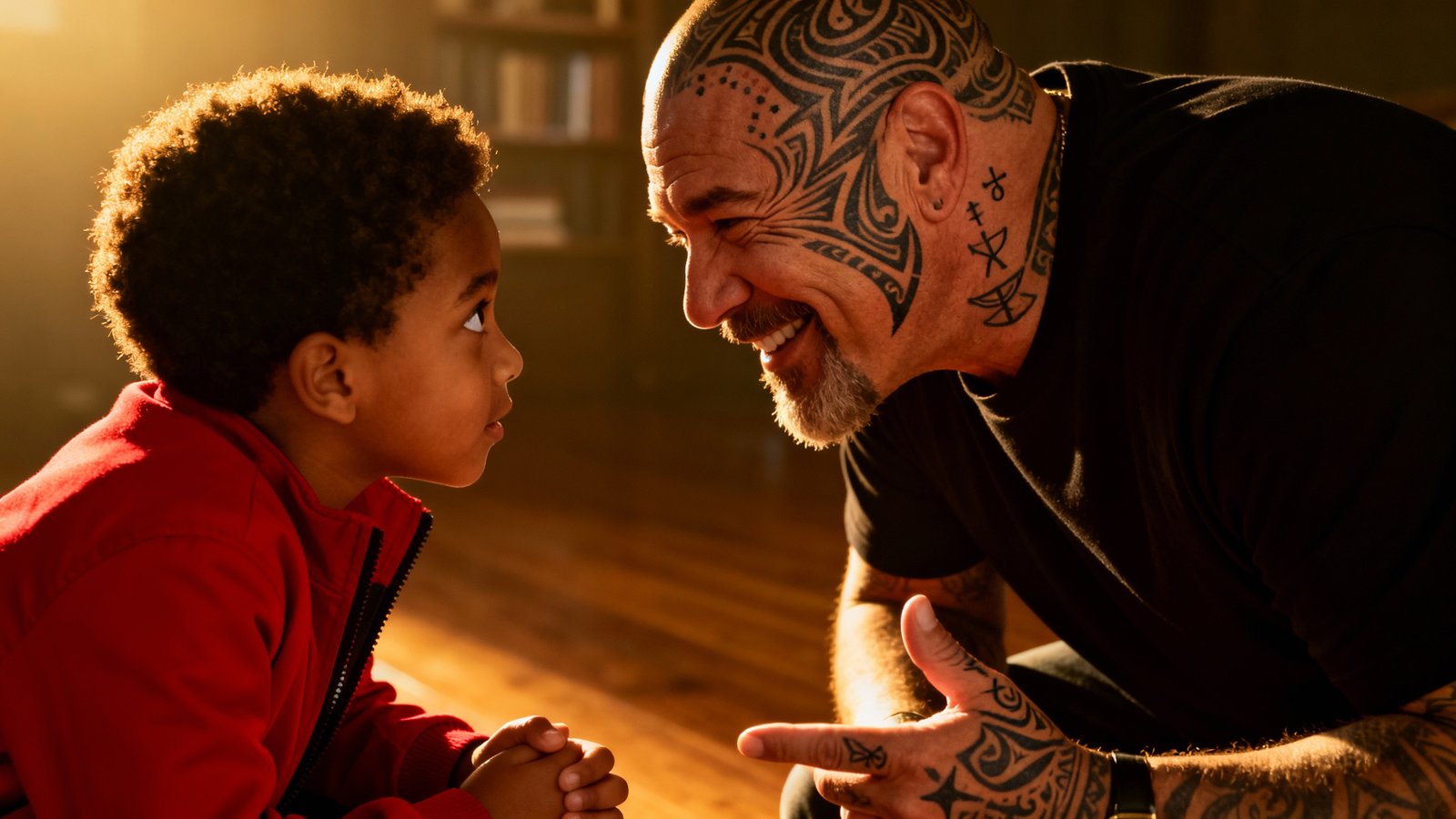
The “Scribbles” Defense, Or: How to Explain a Face Full of Ink to a Five-Year-Old
So here’s the deal. Jelly Roll’s daughter, Bailee Ann, she’s a kid. And kids, bless their hearts, they’re curious. They see stuff, and they ask. Relentlessly. And when your dad looks like a walking art gallery, especially on his face, those questions are gonna come. And not just from her, but from her little friends.
“All of her little friends would go, ‘What is all that stuff on your face?'” the musician told Taste of Country. And I can just picture it, can’t you? A bunch of wide-eyed little ones pointing, maybe a bit scared, maybe just utterly fascinated. And what’s a dad to do? Tell ’em the whole backstory of prison time and rock-and-roll rebellion? Probably not the best move for playdate etiquette.
So what did he do? He sugarcoated it. Big time. He told her they were just “scribbles.” Yeah, scribbles. I mean, not gonna lie, that’s pretty genius in its simplicity. You gotta admire the quick thinking. Because really, what else are you gonna say in that moment? “Oh, these? These are the permanent reminders of youthful indiscretion and a complicated past, sweetie.” Nah, you go with “scribbles.” It’s sweet. It’s innocent. It buys you time. And that, my friends, is basically the entire playbook of modern parenting right there: buy time.
The Art of the Parental Pivot
It reminds me of when my kid asked why the sky was blue. And I, who totally flunked high school physics, just kinda mumbled something about “the ocean reflecting” or some nonsense. Which, you know, isn’t entirely accurate. But it satisfied her for the moment. And that’s the goal, right? To satisfy the immediate curiosity without having to pull out a textbook or, in Jelly Roll’s case, a whole life story that’s probably not suitable for a kindergarten audience.
But here’s the thing. This isn’t just about tattoos. This is about protecting your kids. It’s about preserving that bubble of childhood wonder for as long as humanly possible. Because the world? It’s gonna come at ’em fast enough. It’s gonna hit ’em with all the complicated, messy truths whether we want it to or not. So if you can give ’em a few more years of believing in “scribbles” instead of, well, life, then honestly, who are we to judge?
But What Happens When “Scribbles” Don’t Cut It Anymore?
This is the question that haunts every parent who’s ever, let’s say, creatively interpreted the truth. Because eventually, the kids get older. They get smarter. They start putting two and two together. And “scribbles” suddenly look a lot like, you know, real tattoos. With meanings. And stories.
“All of her little friends would go, ‘What is all that stuff on my face?'”
That moment, the moment of truth-telling, that’s the real challenge. When Bailee Ann is, what, ten? Twelve? And she’s sitting there, maybe with a friend who’s a bit more worldly, and someone goes, “Dude, your dad’s face isn’t scribbles, those are, like, actual tattoos.” What then? That’s when the real conversation has to happen. And I bet you anything, Jelly Roll’s already thinking about it. He’s probably got a whole strategy session planned in his head for that eventual talk.
Because you can’t just keep up the “scribbles” charade forever. Kids aren’t dumb. And you don’t want them to feel like you’ve been lying to them, even if it was with the best intentions. It’s a delicate balance, this parenting gig. It really is.
The Evolution of Explanations
It’s not just about the content of the tattoos, either. It’s about the very idea of them. When Jelly Roll was getting these, tattoos carried a different weight. They still do for some, sure. But culturally, they’ve shifted. They’re more mainstream now. They’re art. They’re self-expression. They’re not just for sailors and bikers and, well, former inmates.
And that’s a whole other layer to this. He’s not just explaining his tattoos, he’s explaining a whole cultural phenomenon to a kid who’s growing up in a world where her teachers probably have sleeves, and her friends’ moms have ankle tattoos. The stigma isn’t what it used to be. Which, in some ways, probably makes the “scribbles” explanation even easier to swallow for a little kid. It normalizes it. It makes it less “scary” or “weird.” It’s just… art.
But it also means the deeper conversation will be different than it might have been twenty, thirty years ago. It won’t be about explaining a taboo. It’ll be about explaining personal choices, consequences, and how sometimes, people change, but their skin art, well, that sticks around. Literally.
What This Actually Means
Look, I think what Jelly Roll did is pretty much what most parents do every single day. We bend the truth, we simplify, we put a positive spin on things that are complicated or messy or, let’s be honest, a little bit dark. Because that’s our job. Our job is to nurture, to protect, to create a safe space for our kids to grow up in. And sometimes, that means delaying the hard truths.
It’s not about being dishonest. It’s about being age-appropriate. It’s about knowing your kid, knowing what they can handle, and when. And it’s about buying yourself some damn time to figure out how to explain the really tough stuff when they’re actually ready to hear it.
So, yeah, Jelly Roll’s face tattoos are a wild ride, and his “scribbles” explanation is a classic. It’s a testament to the universal struggle of parenthood. The struggle to keep a little bit of magic alive, even when your own life story is anything but a fairy tale. And you know what? I respect it. Totally. But I also can’t wait to hear the full, uncensored story he tells Bailee Ann when she’s finally old enough. That, my friends, is gonna be a conversation for the ages. And I bet it’ll be a beautiful, messy, honest one. Just like life.