
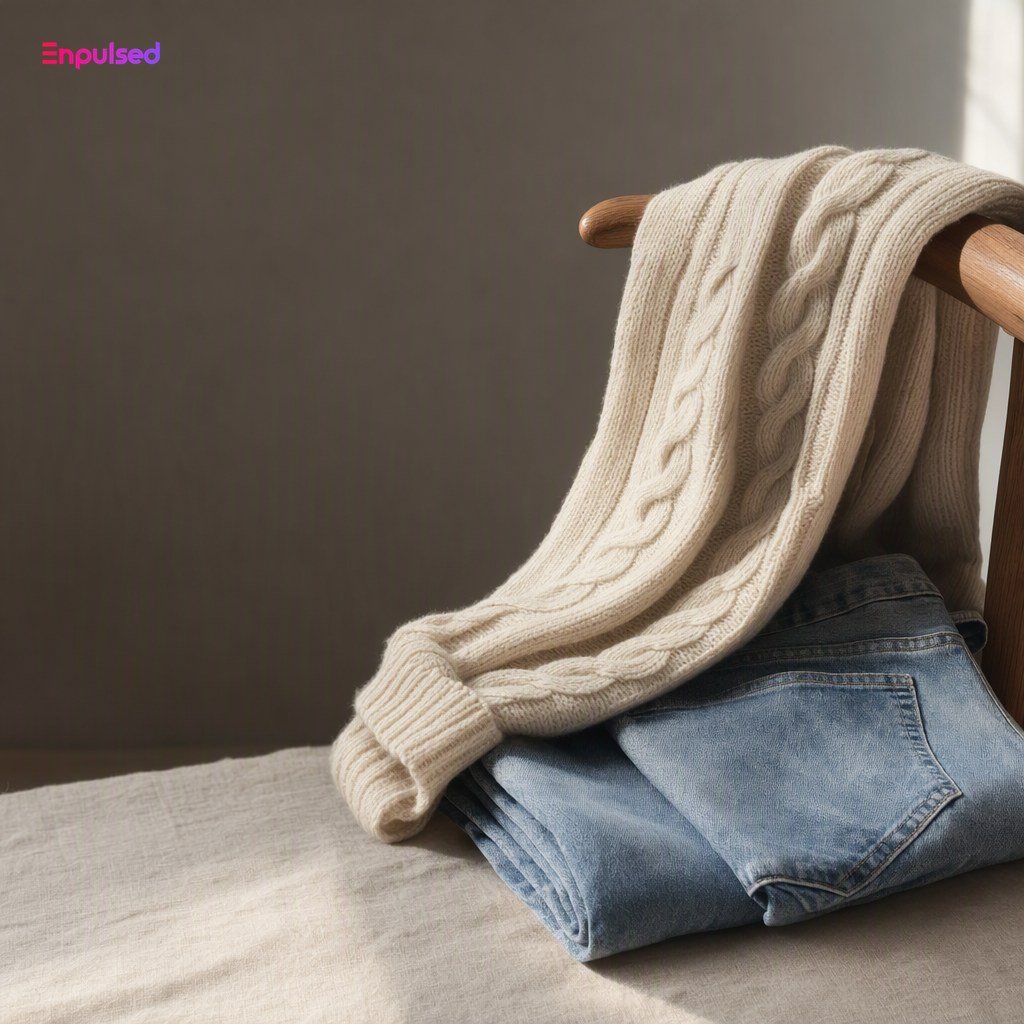
Seventeen sweaters sold on Amazon now start at seven dollars and look nothing like seven-dollar sweaters. A shopping editor at Us Magazine published a roundup in October 2026 after struggling to pair jeans with tops that were neither too casual nor too dressy, too tight nor too shapeless.
The editor’s solution: knits with boutique details—raised floral motifs, bell sleeves, wool blends, necktie accents—at prices between $7 and $30. The article positions these pieces as expensive-looking alternatives to both oversized frumpy styles and unflattering fitted ones.
What makes a $7 sweater look boutique
The editor’s top pick features a raised floral pattern and fabric described as cashmere-looking. The runner-up is a hybrid cardigan-top with front buttons and bell sleeves. Other selections include embroidered cardigans, chunky cable-knits in cerulean and khaki, and a high-neck blouse the editor says “stuns with jeans and trousers alike.”
Several pieces use construction tricks to flatter: tie-front designs that hide bloating, bell sleeves that conceal upper arms, slouchy cream tones for “rich mom vibes.” One $19 cardigan is called out for its tailored shape and wool-blend fabric. Another, a black pullover priced at $7, is described as a “wardrobe MVP.”
The timing: rich-girl fall and boutique aesthetic
The October 2026 publish date places the story at the start of fall shopping season. The article references a separate piece on Jennifer Lawrence wearing colorful fall sweaters instead of neutrals, a signal that the “rich mom” aesthetic had moved beyond beige and camel by that point.
The language throughout the roundup leans on luxury cues: “boutique details,” “polished perfection,” “country club socialite,” “Hamptons energy.” One cardigan is compared to Free People. Another is said to make wearers “look like” they spent hundreds. The framing treats Amazon as a place to access high-end aesthetics at a fraction of the cost.
What this signals about fast-fashion aesthetics
The existence of a $7 sweater marketed as boutique-quality reflects two trends. First, fast fashion has become skilled at mimicking premium details—cable knits, embroidery, textured fabrics—at scale. Second, aspirational language in affiliate commerce content now assumes readers want to “look expensive” without spending accordingly.
The article includes an affiliate disclosure: Us Magazine receives compensation when readers click and purchase. That business model depends on volume, which requires accessible price points. Seven dollars is low enough to convert impulse clicks into sales, while “boutique-inspired” frames the purchase as taste rather than thrift.
The jeans pairing problem
The editor’s stated problem—not knowing what tops to wear with jeans—is a wardrobe gap many encounter. Jeans are neutral enough to pair with almost anything, which paradoxically makes them harder to style. Too-casual tops make the outfit feel unfinished; too-formal tops create friction. The sweet spot is polished but relaxed, which is exactly what the roundup promises.
The editor emphasizes versatility: errands, date nights, in-office Fridays. That range suggests these sweaters are meant to replace multiple categories—weekend wear, business casual, evening casual—with one flexible type of garment. If the claim holds, a $7 sweater that works in three contexts is a better value than a $50 sweater that works in one.
Who this serves
The intended reader is someone with jeans in rotation who lacks the tops to complete outfits, someone who wants to look put-together without spending boutique prices, and someone willing to shop Amazon for clothing. The tone is enthusiastic but not pushy, personal but not niche. The editor positions herself as having solved her own problem, then sharing the solution.
The broader context is affiliate-driven editorial content, where media outlets monetize product recommendations. The model works when the recommendations are genuinely useful and priced low enough that the friction of a potential mistake is minimal. A $7 sweater that disappoints is a smaller loss than a $70 one, which makes the click easier to convert.