

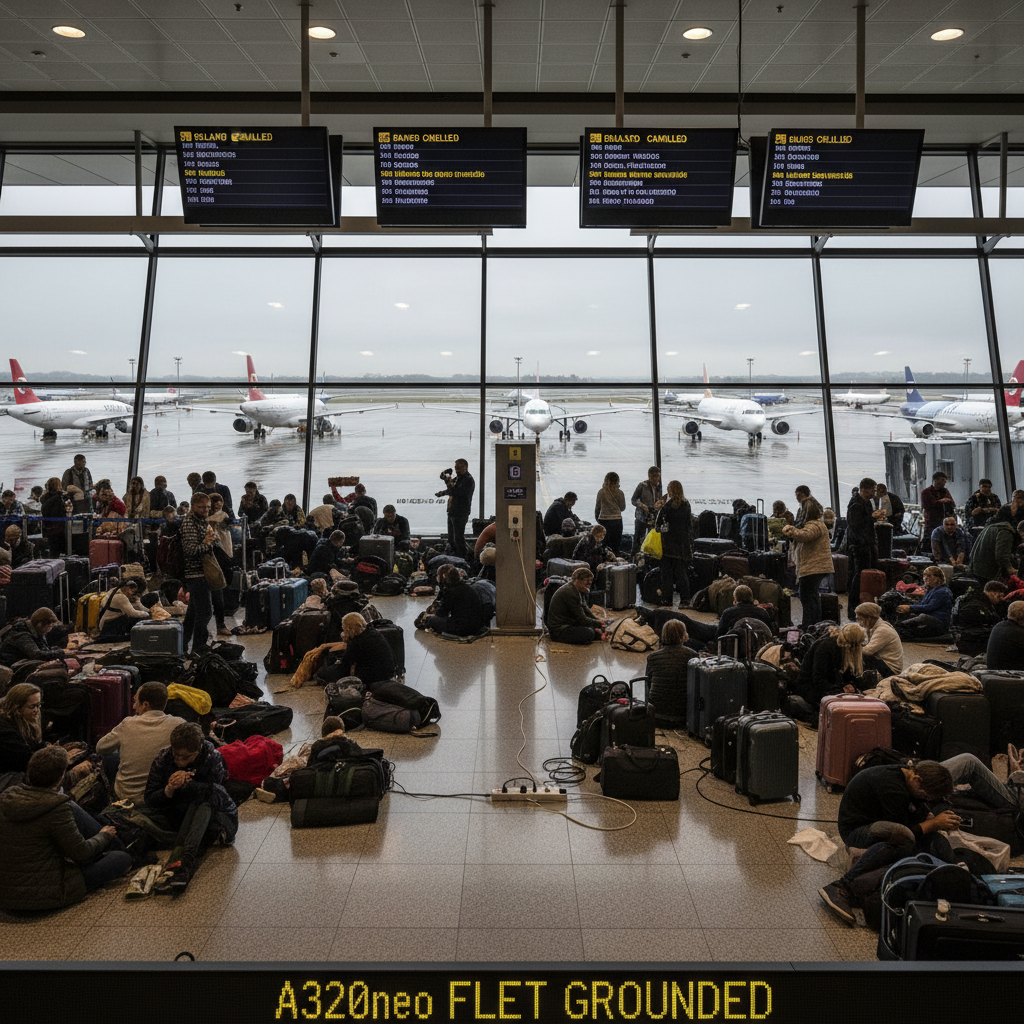
Okay, so imagine this: you’re just trying to get from Point A to Point B, maybe for that much-needed vacation or that make-or-break business meeting, and suddenly, the plane you’re supposed to be on-or one just like it, flying thousands of other people-has a big problem. Not a “minor delay” problem, but a “might need to be recalled” problem. That’s the unsettling hum currently buzzing around the global aviation industry, specifically involving the workhorse of the skies, the Airbus A320 family.
We’re talking about a significant chunk of the world’s commercial fleet here, not just a few planes. The A320-neo models, in particular, are facing a bit of a crisis related to their Pratt & Whitney engines. It’s essentially a component inside the engine-a powder metal part-that’s raising some serious eyebrows and, more importantly, safety concerns. The idea of grounding or even intensely inspecting hundreds of these aircraft simultaneously? That could, quite frankly, throw a massive wrench into global air travel plans. Chaos? It’s not out of the question.
The Heart of the Problem-and Its Global Reach
So, what exactly is happening? Pratt & Whitney-one of the big names in aircraft engines-has flagged an issue with a specific part in some of their geared turbofan (GTF) engines. These aren’t just any engines; they’re the ones powering a good number of the newer generation A320neo jets. The flaw, or potential flaw, is in a high-pressure turbine disc made from powder metal, which, you know, ideally shouldn’t have any structural weaknesses. If it does, well, that’s a safety nightmare waiting to happen.
The impact, as you can imagine, isn’t just felt by one airline or one region. This isn’t like a quirky little problem with a particular batch of in-flight peanuts. We’re talking airlines stretching from the bustling hubs of India to the sprawling networks of Europe and North America. It’s truly global in scope, affecting carriers that rely heavily on these fuel-efficient narrow-body jets for their daily operations. Think about the domino effect: one grounded plane isn’t just one less flight; it’s a ripple through schedules, crew rotations, and passenger connections. It’s a logistical migraine, honestly.
Who’s Sweating About This?
Basically, any airline that’s embraced the A320neo family, especially those with the specific Pratt & Whitney GTF engines manufactured between 2015 and 2021, is currently running through mental spreadsheets and contingency plans. You’ve got your Wizz Airs that have practically built their fleet around these planes, flying tens of millions of passengers annually. Then there’s Spirit Airlines in the US, another low-cost carrier heavily invested in the platform. IndiGo, a massive player in India, also has a significant number in their operational fleet. The list goes on, which is precisely why this isn’t just a blip; it’s a potential groundswell.
- Point: Affected airlines are facing operational disruptions, something they absolutely hate after the rollercoaster of the pandemic.
- Insight: This could mean fewer flights, revised schedules, angry passengers, and big financial hits if planes are out of commission for inspection or repair for extended periods. It’s not just the cost of repair; it’s the cost of lost revenue.
“The sheer scale of the A320neo’s presence in global fleets means any widespread issue is essentially a systemic risk for the entire travel industry.”
What Happens Next? The Inspection Frenzy
Now, you might think, “Okay, so they’ll just fix it, right?” Well, it’s not quite that simple. Pratt & Whitney has mandated accelerated inspections, meaning engines need to be pulled off planes, partially disassembled, and meticulously checked. This isn’t a quick once-over; it’s a substantial maintenance event. And they’re not just looking at a handful of engines; it’s hundreds, potentially thousands, that fall within the problematic manufacturing window. It’s like asking every single owner of a widely popular car model to bring their vehicle in for an immediate, complex engine surgery.
The Ripple Effect in Airspace
The immediate consequence is a huge surge in demand for maintenance slots, mechanics, and spare parts. MRO (Maintenance, Repair, and Overhaul) facilities are going to be absolutely swamped. This isn’t just about scheduling; it’s about capacity. Airlines might find themselves scrambling for available slots, leading to longer periods where their aircraft are out of service. And those aircraft aren’t just sitting there; they’re integral parts of a finely tuned global transportation machine. Remove one cog, and things can very quickly start to grind.
Consider the summer travel season-peak time for many carriers. If a significant number of A320neos are unavailable, even for a few weeks, it’s going to hit hard. Passengers could see more cancellations, higher ticket prices due to reduced capacity, and generally a lot more headaches. For some airlines, which might already be operating on thin margins, this could be a really difficult pill to swallow. It tests their resilience, their ability to adapt, and frankly, their finances. We’ve seen how quickly disruptions can cascade, and this has all the hallmarks of a really challenging scenario.
This situation really underlines something often overlooked by casual travelers: the incredible complexity and interdependence of the airline industry. Every single part, every single engine, every single plane has to work perfectly, or nearly perfectly, for the whole system to function smoothly. When a widespread issue arises with a critical component on a ubiquitous aircraft type, it’s not just a technical hiccup-it’s an operational earthquake with potential economic aftershocks.
So, global chaos looms? It’s not a certainty, thankfully, as these recalls and inspections are precisely how serious accidents are prevented. But the path to resolution won’t be smooth. Expect some turbulence in the coming months for airlines, and perhaps for your own travel plans, as the industry navigates this latest challenge to the skies. It’s a reminder that even the most advanced machines, and the systems that support them, are, at their core, human endeavors, subject to the occasional, sometimes very complex, flaw.