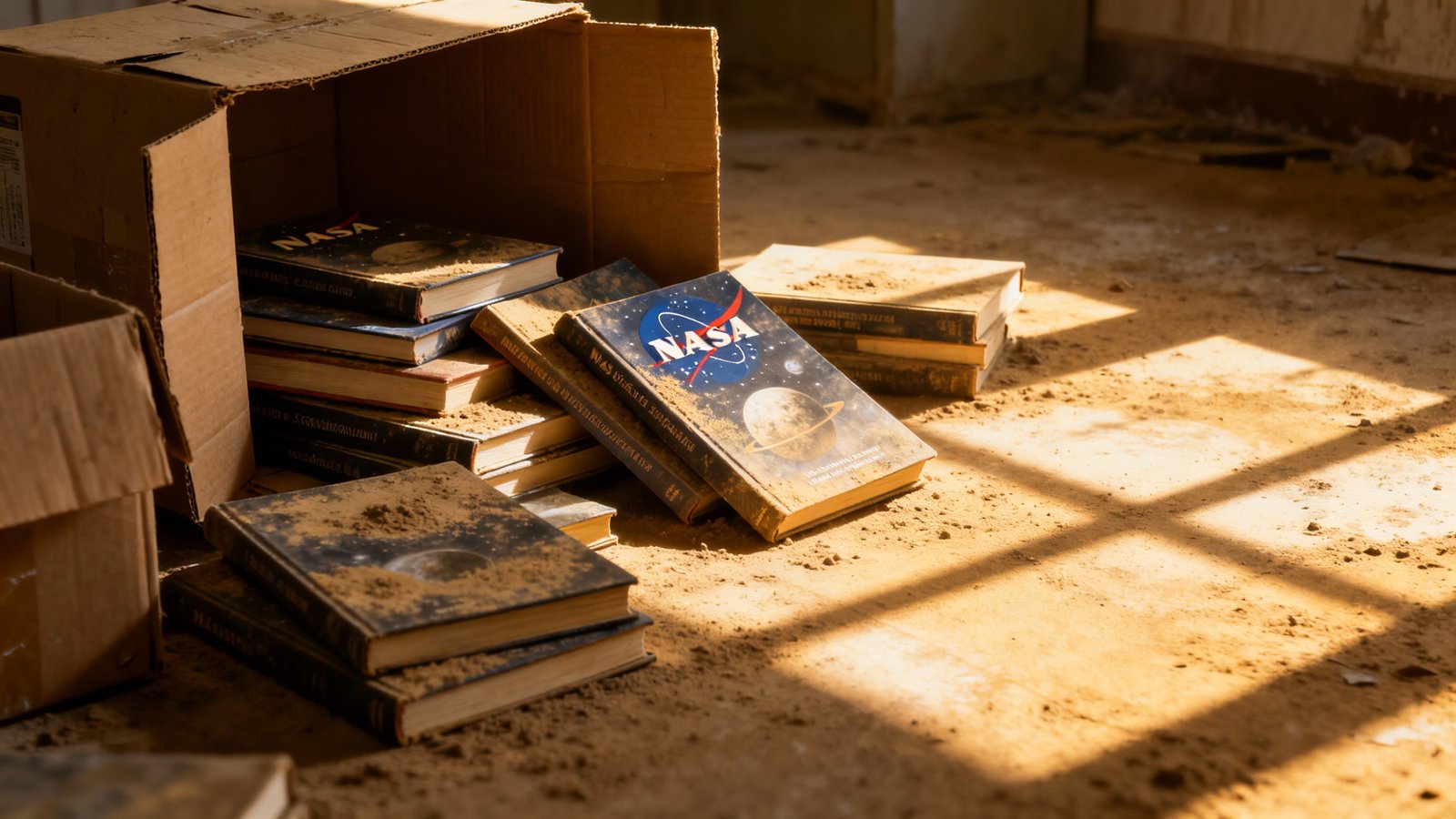
So, get this. NASA. Yeah, that NASA. The one that sends rockets to Mars, takes pretty pictures of distant galaxies, and generally makes us all feel like maybe, just maybe, humanity isn’t a total dumpster fire. They’re throwing out their books. Literally. Into the dump. Like old pizza boxes or a broken toaster. Because, you know, who needs knowledge when you’ve got… well, I guess nothing, if you’re throwing out all the good stuff.
“Houston, We Have a Problem” – And It’s Not a Spaceship
I saw the headline and, not gonna lie, I actually snorted coffee. NASA’s largest library, permanently closing on January 2nd. And the books? They’ll be “tossed away.” Tossed away. Like they’re trash. We’re talking about NASA, people! The agency that stands for discovery, innovation, pushing the boundaries of human understanding. And their library, probably full of irreplaceable research, historical documents, unique data that might not exist anywhere else in the world, is getting the heave-ho.
It’s just… I mean, seriously? This isn’t some dusty old public library full of romance novels from the 70s (no offense to those, they have their place!). This is NASA. Think about the stuff that’s in there. We’re talking about the actual, physical records of how we got to the moon. The original schematics, the calculations, the observations from missions long past. Stuff that predates the internet, you know? Things that might have been digitized, sure, but sometimes the original physical artifact just is different. It holds a different kind of truth, a different kind of detail. And sometimes, you just need to browse. To stumble upon something unexpected. That’s how discovery often happens, isn’t it? Not by typing a specific keyword into a database.
The Irreplaceable and The “Obsolete”
The thing is, a lot of this material, especially the older stuff, it’s probably one-of-a-kind. Or at least, very, very rare. We’re talking about historical records of space exploration. The early days of rocketry. Theoretical physics from before the digital age. I’ve heard the argument, “Oh, it’s all digitized now.” And yeah, that’s great. Digital copies are essential for accessibility. But what happens when a file gets corrupted? When a format becomes obsolete? When the server crashes? We’ve seen this pattern before, haven’t we? Relying solely on digital copies is like building a house on quicksand. Physical books, they last. They survive power outages. They don’t need a software update. You can spill coffee on them and probably still read most of it.
Is This Just “Progress,” Or Something More Sinister?
So, what’s really going on here? Is it budget cuts? Is it some misguided notion of “modernization” where anything not on a screen is considered obsolete? Look, I get it, space exploration is expensive. But a library? A repository of knowledge? That’s the foundation of what NASA does. You don’t build a house by tearing down its basement.
“It’s not just about losing books; it’s about erasing the physical memory of how we learned to touch the stars.”
This isn’t just a practical problem; it’s a symbolic one. It sends a message. A really, really bad message. It says that physical knowledge, history, the tactile experience of learning, isn’t important. That if it’s not immediately searchable on Google, it has no value. And that’s a dangerous path to go down, my friends. Because what happens when the internet goes down? Or when the algorithms decide certain information isn’t “relevant” anymore? Who cares then?
The Slow Erosion of Institutional Memory
This is a broader trend, too. Libraries everywhere are fighting for their lives. Universities are ditching physical collections for digital ones. And while digital access is vital, it shouldn’t come at the cost of the originals. Especially for an institution like NASA, where every single scrap of data, every observation, every failed experiment, holds potential value for future generations. What if some old, forgotten research holds the key to a new propulsion system? Or a solution to a problem we haven’t even encountered yet?
It’s not just about the information in the books, either. It’s about the context. The marginalia. The way information was presented and organized in its original form. Sometimes, the physical object itself tells a story. And that’s something a PDF just can’t replicate. You lose a piece of the puzzle, a chunk of institutional memory. And for an agency built on incredibly complex, long-term projects, that’s a huge, colossal, almost criminal oversight.
What This Actually Means
So, here’s what this actually means. It means we’re getting lazy. It means we’re prioritizing short-term convenience over long-term preservation. It means we’re gambling with our collective knowledge, putting all our eggs into the digital basket, which, let’s be honest, is far more fragile than a bookshelf full of hardbacks.
This isn’t some abstract philosophical debate about paper versus pixels. This is NASA, for crying out loud. The place where some of the smartest people on the planet work, making incredible breakthroughs. And they’re just… tossing away their legacy. Their history. Their literal reference materials. It’s like a chef throwing out all their old cookbooks because they have an iPad now. Madness. Pure, unadulterated madness.
I don’t know who made this decision, or why, but it’s a bad one. A really, really bad one. And we should be paying attention. Because if NASA thinks its physical library is disposable, what’s next? What other invaluable collections are quietly being “tossed away” in the name of progress, or budget cuts, or whatever flimsy excuse they’re using this week? It’s a sad day for knowledge, that’s what it is. A damn sad day.