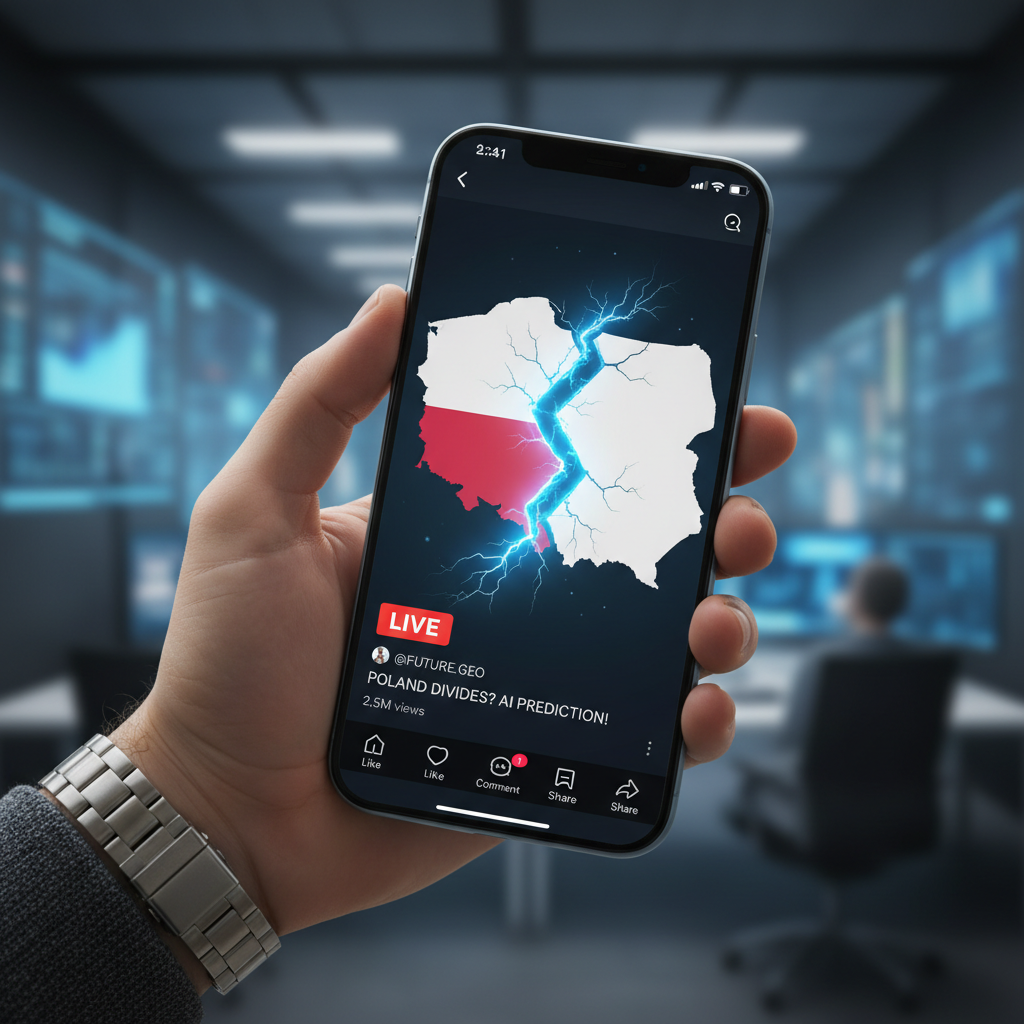
Okay, so imagine scrolling through your TikTok feed, maybe catching up on dance trends or someone’s latest cooking disaster, when you stumble upon something… really unsettling. We’re talking slick, professional-looking videos, perhaps featuring a perfectly rendered, synthetic voice, or even an AI-generated face, all passionately advocating for something called “Polexit.” That’s Poland leaving the European Union, just like Brexit, but, you know, for Poland. Sounds like something out of a near-future dystopian thriller, doesn’t it?
Well, turns out, it’s not fiction. Not anymore. Poland has actually called for the EU to take serious action against these kinds of AI-generated TikTok videos. It’s a proper alarm bell, isn’t it? A country, a member state, essentially saying, “Hey, we’ve got a problem here, and it’s not just a few trolls in a basement- it’s something much more sophisticated, much more dangerous, and it’s trying to tear us apart.” It kinda makes you pause and think about what’s lurking just beneath the surface of our seemingly innocuous social media feeds.
This isn’t just about a few rogue algorithms; it’s about the weaponization of technology against democratic processes. The digital wild west we’ve been navigating for years? It just got a whole lot wilder, and frankly, a lot scarier, with AI now in the mix, churning out convincing-looking propaganda faster than you can say “deepfake.”
The Creepy Precision of AI Propaganda
Here’s where it gets truly unsettling: these aren’t your grandpa’s clumsy propaganda pamphlets. We’re talking about content that can be tailored with chilling precision. Imagine an AI analyzing vast datasets of social media interactions, political leanings, and even emotional responses to specific keywords. Then, it crafts videos designed to hit just the right nerve, to exploit existing anxieties, to amplify divisions that might already be simmering. It’s not just spreading a message- it’s optimizing it for maximum impact, for maximum divisiveness. And on a platform like TikTok, with its incredibly potent algorithms, that content can spread like wildfire, reaching millions before anyone even blinks.
Who’s Behind the Curtain? And Why Poland?
Now, you might be wondering, who’s doing this? And why Poland, specifically? Well, the “who” is the million-dollar question, isn’t it? It could be foreign state actors looking to destabilize the EU, or perhaps even domestic fringe groups leveraging new tech. The beautiful (and terrifying) thing about AI-generated content is its plausible deniability. It’s hard to trace, hard to attribute definitively. As for Poland, it’s a country with a complex relationship with the EU-a robust economy that benefits greatly from membership, yes, but also a history of nationalist sentiment and recent political tensions with Brussels over judicial independence and rule of law. It’s fertile ground, unfortunately, for narratives that suggest the EU is somehow undermining national sovereignty. A perfect target for this kind of digital mischief, if you ask me.
- Point: AI-generated content can bypass traditional gatekeepers of information, flooding social media with seemingly legitimate-but entirely fabricated-narratives. It’s like a digital Trojan horse, basically.
- Insight: The speed and scale at which these videos can be produced and disseminated make them an unprecedented threat to democratic discourse. We’re talking about a firehose of propaganda, not a trickle.

The EU’s Regulatory Tightrope Walk
So, Poland calls for action. And rightly so. But what kind of action can the EU actually take? It’s a real head-scratcher, honestly. The European Union has been trying to get a handle on digital content for a while now, with things like the Digital Services Act (DSA) aimed at making platforms more accountable. But AI throws a whole new wrench into the works. How do you regulate something that’s constantly evolving, that can be used for good just as easily as it can be used for ill? It’s like trying to catch smoke with a net.
The DSA’s New Test: AI and Deception
The DSA, which is already a pretty comprehensive piece of legislation, mandates that very large online platforms – like TikTok – must assess and mitigate systemic risks, including those related to disinformation and foreign interference. But AI-generated content, especially deepfakes and synthetic voices, presents a unique challenge. It blurs the line between legitimate political expression and outright deception. If a video looks and sounds perfectly human, how do we expect the average user to tell the difference? Or even the platforms themselves, without some serious, costly, and perhaps privacy-invasive detection tech?
“This isn’t just about identifying fake news anymore; it’s about distinguishing between genuine human expression and sophisticated digital mimicry, a task that’s becoming exponentially harder with every new AI advancement.”
It forces us to ask some uncomfortable questions: Is TikTok responsible for every piece of content that gets uploaded? Where does the responsibility lie-with the creator of the AI model, the person who prompts it, or the platform that hosts it? It’s a legal and ethical minefield, and frankly, nobody has all the answers yet. But the clock is ticking, you know? Because while we’re debating, these videos are out there, potentially swaying public opinion, eroding trust.

Beyond Poland: A Threat to Democracy Itself
While the immediate concern is “Polexit,” the implications of this go far beyond Poland’s borders. This isn’t just about one country’s political future; it’s about the very fabric of democratic societies. If AI can be used to generate convincing-enough content to manipulate elections, to push divisive agendas, to erode public trust in institutions and each other, then we’re in serious trouble. We’re talking about a future where truth becomes a commodity, where reality is negotiable, and where trust-the cornerstone of any functioning society-is utterly obliterated. It’s a scary thought, right? And it’s not some far-off sci-fi scenario; it’s happening, right now, on our phones.
Think about it: every election, every public debate, every major policy decision could be undermined by an invisible army of AI-generated content, tailored to specific demographics, designed to sow discord and confusion. It makes the old days of state-sponsored newspaper propaganda look quaint, doesn’t it? This is a whole new beast, one that evolves daily.
Ultimately, Poland’s call to action isn’t just a plea for help; it’s a wake-up call for all of us. It’s a stark reminder that the tools we create, no matter how amazing or innovative, can be twisted and used against us. The fight against AI-generated disinformation isn’t just about regulations and tech fixes-it’s about digital literacy, about critical thinking, and about fostering a public that’s savvy enough to question what they see, even when it looks perfectly real. Because if we don’t get a handle on this, the future of our democracies might just be decided by algorithms, and that, my friends, is a future none of us should want.