
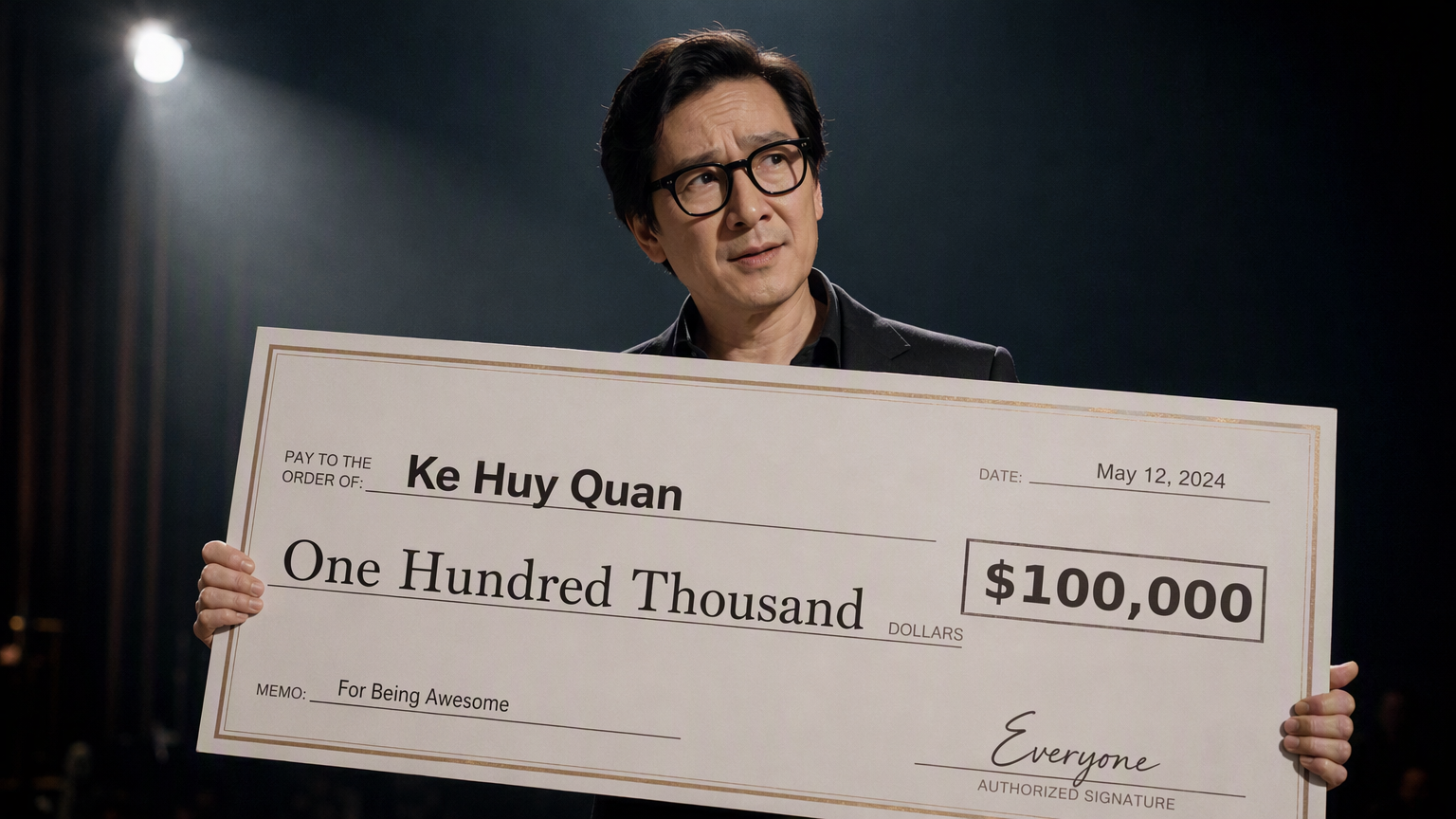
Ke Huy Quan was a kid when he opened an envelope and found a check for $100,000 inside. Not a movie prop check. A real one. And his first reaction wasn’t excitement, it was confusion. “It didn’t make any sense,” he’s said, and honestly? Same. Try explaining residuals to an 11 year old and see how far you get.
Wait, He Got Paid AFTER the Movie Came Out?
Here’s the thing about residuals that a lot of people don’t actually understand until they’re staring at one (or, you know, reading about someone else staring at one). Quan played Short Round in “Indiana Jones and the Temple of Doom” back in 1984, and residuals are basically the entertainment industry’s way of saying “hey, this thing you worked on is still making money, so here’s your cut.” It’s not a bonus. It’s not a gift. It’s baked into how the business works, and it’s been that way for decades thanks to union contracts fighting for exactly this.

But try telling that to a kid. Quan wasn’t thinking about SAG-AFTRA contracts or syndication deals. He was thinking, wait, why is there a check with six figures on it showing up out of nowhere? For a kid actor whose family had emigrated from Vietnam, that kind of money wasn’t just surprising, it was genuinely life altering. And I think that’s the part that gets lost when people talk about child stars and money – we love to talk about the ones who blew it all, but we don’t talk enough about what it actually feels like to be a kid who suddenly has access to real, serious money because grown-ups signed some paperwork on your behalf.
The Math Behind the Mystery
Look, residuals aren’t random. They’re tied to reruns, syndication, home video sales, all that stuff. “Temple of Doom” was a massive hit, and Lucasfilm/Paramount kept finding new ways to put it in front of audiences for years. TV airings alone can generate serious residual income if a movie has staying power, and let’s be real, an Indiana Jones movie has staying power. So on paper, the check makes total sense. To a kid who just wants to go outside and play? Not so much.
Why This Story Actually Matters (Not Just a Fun Fact)
I could stop here and just say “aw, cute story, kid got rich, moving on.” But that undersells what’s actually going on. Quan’s career took a nosedive after his early success – he’s talked openly about the years he spent barely getting auditions, questioning whether Hollywood had any place for an Asian actor who wasn’t a kid anymore. That $100k check wasn’t just life-changing in the moment. It was, in some ways, a strange preview of a career that would have wild highs and painfully quiet lows before circling back around decades later with “Everything Everywhere All at Once.”

“It didn’t make any sense to me. I was a kid. I just remember thinking, why is this happening?”
That quote right there? That’s the whole story in one sentence. A kid trying to process an adult financial concept while probably still worried about homework or whatever kids worry about. I mean, put yourself in his shoes for a second – one day you’re just an actor on a wild adventure movie with Harrison Ford, and the next you’re holding a check that could buy a house. Nobody prepares you for that. Nobody can.
Child Stardom Money Talk Is Always Messy
We don’t talk about this stuff enough, honestly. Not gonna lie, most conversations about child actors and money go straight to the horror stories – trust funds getting drained, parents mismanaging everything, lawsuits, the whole mess. And yeah, that happens, it happens a lot actually. But Quan’s story is a little different because it’s not really about mismanagement. It’s about the sheer disorientation of being a kid who doesn’t yet have the framework to understand what money even represents at that scale.

Think about it this way – most adults struggle to wrap their heads around residual payments, syndication deals, and royalty structures. These systems exist specifically because Hollywood historically tried to shortchange actors on the back end, and unions had to fight tooth and nail to establish protections. So when a kid gets a check that represents years of institutional labor advocacy boiled down into a single number, of course it “doesn’t make sense.” It’s not supposed to make immediate sense. It’s supposed to represent value accumulated over time, which is a pretty abstract concept even for plenty of grown adults.
What’s interesting here is how Quan frames it now, decades later, with the benefit of hindsight and, frankly, an Oscar. He’s not bitter about it. He’s not framing it as some traumatic financial confusion. He seems almost amused by it, like he’s still a little bit that confused kid opening an envelope and going “…huh?” And I kind of love that. There’s no bitterness in the story, just genuine bewilderment that’s aged into a good anecdote.
What This Actually Means
I think the real takeaway here isn’t really about the dollar amount at all. It’s about how weird it is that we hand kids massive financial windfalls and expect them to just… deal with it. No manual included. Quan got lucky in the sense that this story has a happy ending – he didn’t lose it all, didn’t get exploited (as far as we know), and eventually built a career that came full circle in a way almost nobody could’ve predicted back in 1984.
But for every Ke Huy Quan story that ends up being a charming anecdote on a press tour, there’s probably another kid actor out there whose “didn’t make sense” moment turned into something a lot messier. That’s the part worth sitting with. The confusion isn’t the funny part. The confusion is the whole point – and maybe the industry should think a little harder about that instead of just cutting checks and calling it a day.