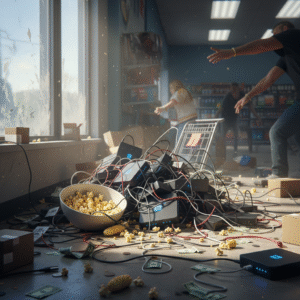
I mean, seriously? This isn’t some conspiracy theory from a dimly lit corner of the internet. This is the kind of headline that makes you want to throw your coffee cup at the wall. Because if this is true – and all signs, from what I’m seeing and hearing and just feeling in the air, point to a big fat YES – then we didn’t just spend $30 billion. We spent $30 billion to make our kids… well, less smart. And for what? For a bunch of glowing screens that probably cost more in repair bills than they ever saved in paper?
The Great Digital Dream (or Nightmare)
Look, I remember when this whole “one-to-one device” thing started getting traction. Everyone, and I mean everyone, was buzzing about it. It was the future! Kids were “digital natives,” they said. They’d learn better, faster, more interactively. Textbooks were archaic, heavy, outdated. We needed to prepare them for the 21st century, for a world of coding and AI and who knows what else. It all sounded so… progressive, didn’t it?
And yeah, I get it. There’s a part of me that bought into the hype, too. A little. You want to believe in progress, right? You want to believe that throwing money at a problem, especially when it involves cool tech, will fix things. But the thing is, even back then, there were whispers. Quiet voices saying, “Hey, wait a minute. What about deep reading? What about handwriting? What about just… looking at another human being instead of a screen for eight hours a day?” Those voices, of course, got drowned out by the roar of innovation and the clatter of keyboards.
So we dove headfirst into this digital ocean. Every kid got a laptop, a tablet. Teachers got training (or sometimes, they just got a device and a shrug). School districts signed massive contracts. The tech companies? Oh, they made out like bandits. Thirty billion dollars, baby. That’s a lot of iPads. That’s a lot of Chromebooks. That’s a lot of… well, potential cognitive decline, apparently.
What Were We Thinking, Honestly?
Here’s the rub: When you spend that kind of cash, you’re making a bet. A huge bet. And you’d think, wouldn’t you, that you’d have some serious, rock-solid evidence that this bet was a good one before you put all your chips on the table? From what I can tell, and from what we’re seeing now, that evidence was… kinda flimsy. Or at least, it didn’t account for the actual human element. The squishy, distractible, easily-bored human element, especially when that human element is, you know, a kid.
So, Did We Trade Brainpower for Blue Light?
This isn’t just about reading comprehension, though that’s a big part of it. This is about attention spans. This is about critical thinking. This is about the ability to sit with a complex idea, to process it slowly, to let it marinate in your brain without the constant siren song of a notification, a game, or a YouTube rabbit hole.
“We’ve optimized for convenience, not for cognition. And now we’re seeing the bill.”
Think about it: a physical book. It’s finite. You turn pages. You feel the weight of it. You can’t just tap away to Instagram. A screen? It’s a portal to everything. And for a kid trying to focus on, say, the causes of the Civil War, “everything” is a pretty compelling distraction. It’s not just the screen itself, it’s the ecosystem of the screen. The constant pings, the easy escape routes, the sheer infinite scroll of distractions. How many kids actually use those laptops for deep, sustained learning versus, you know, browsing memes or playing unblocked games? Be honest.
And the writing. Oh god, the writing. We used to teach kids to write. With their hands. Developing fine motor skills, connecting different parts of the brain. Now it’s all typing. Which is useful, sure. But it’s not the same. It’s just not. Our brains are wired for touch, for physical interaction. Taking that away, reducing everything to a flat, glowing surface, it has to have an impact. Right? It just has to.
What This Actually Means
This isn’t some abstract academic debate anymore. This is about a generation. Our kids. The ones who are going to be running things someday. And if they’re “less cognitively capable” – which, let’s be blunt, is a fancy way of saying “dumber” – then that’s a problem that goes way, way beyond a bad return on investment.
It means we’ve fundamentally altered how young brains develop, how they process information, how they engage with the world. And honestly, it feels like we did it without really understanding the long-term consequences. We were so busy chasing the next big thing, the “innovative” solution, that we forgot to ask if the old way, the slow way, the messy way, was actually the better way for some things. Especially for foundational learning.
So what now? Do we just shrug and say, “Oops, our bad, kids”? Do we start ripping tablets out of their hands and reintroducing actual paper and pencils and, gasp, textbooks? It’s not gonna be easy. Because once you’ve given a kid a screen, it’s pretty darn hard to take it away. We’ve created a dependency, a habit. A very, very expensive habit.
This whole thing just makes me so mad, you know? Because it feels like such a preventable screw-up. We had the warnings. We had the common sense. And we chose the shiny, expensive path anyway. Thirty billion dollars. And for what? For a generation that might just be staring blankly at us, wondering who exactly messed up their brains. And who cares, really, about the money? The real cost here is way, way bigger.