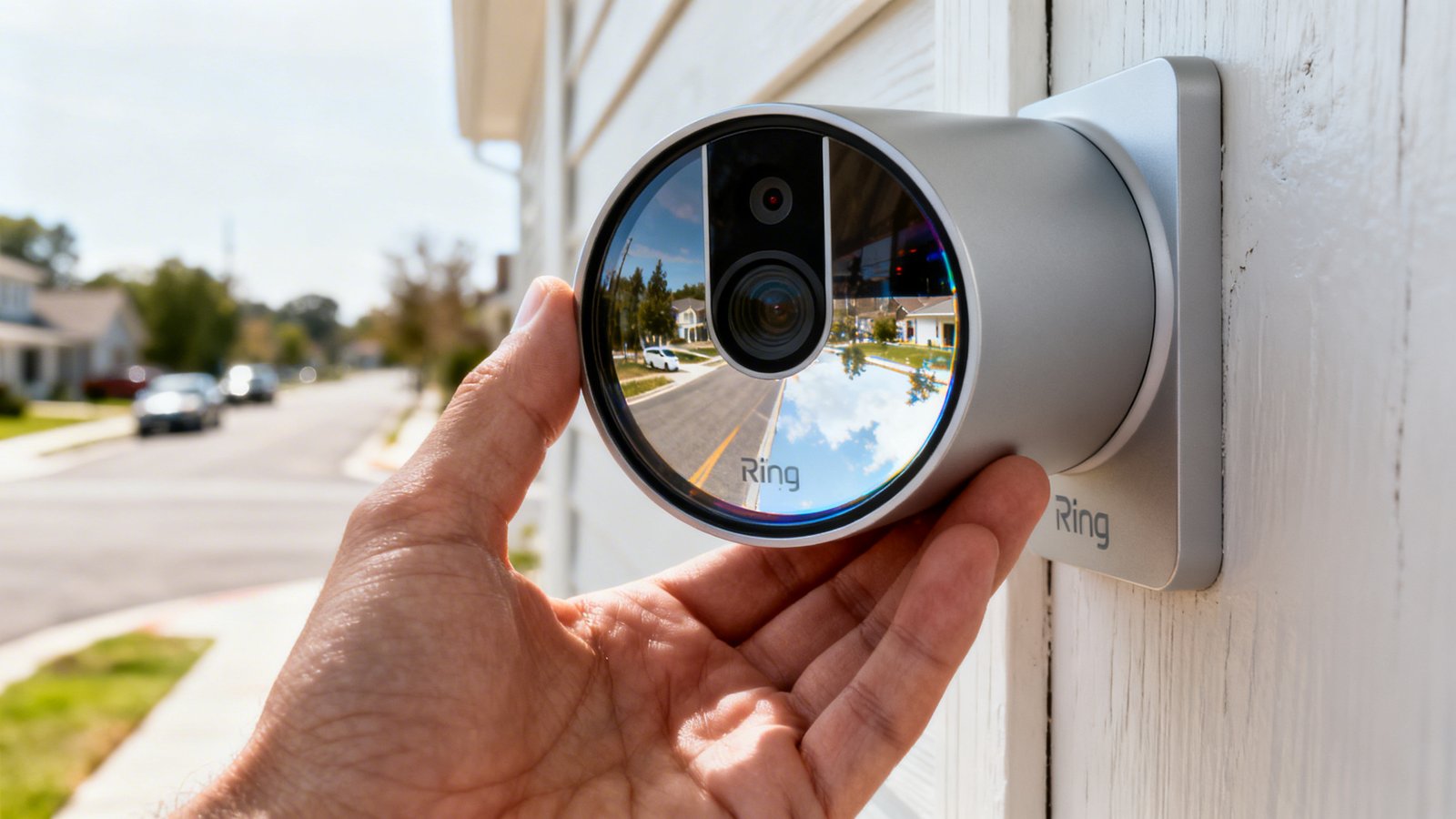
Alright, let’s just cut to the chase, because this whole Ring thing? It’s been bugging me for years. Seriously. It’s not some grand conspiracy theory, not anymore anyway. It’s right there, staring us in the face. We, the regular folks, the consumers, we built the damn surveillance state. Not some shadowy government agency, not some black ops crew. Nope. It was you. And me. And Brenda down the street who just wanted to see who was snatching her Amazon packages. We did it. With a doorbell cam.
The Great American Surveillance Project
I remember when Ring first started popping up everywhere. It felt like… I don’t know, a good idea? At first, right? A little peace of mind. Catch that porch pirate. See if the kids got home from school okay. Totally reasonable stuff. And Amazon, being Amazon, swooped in and bought them up in 2018 for a cool billion dollars. A billion. Think about that for a second. For a doorbell. That should’ve been our first clue, shouldn’t it? That this wasn’t just about convenience.
The thing is, it wasn’t just your Ring camera. It was yours, and your neighbor’s, and your other neighbor’s. And pretty soon, the entire block, maybe even the whole subdivision, was basically blanketed in these things. A patchwork quilt of digital eyes, all feeding into one giant network. And who runs that network? Oh yeah, Amazon. Of course.
And then came the really insidious part: the partnerships. Ring didn’t just sell you a camera. They actively, aggressively, partnered with local police departments across the country. They basically gave them a VIP pass to all this footage. Not just, “hey, we’ll give you footage if there’s a crime,” but more like, “here’s a portal, go nuts. Ask for whatever you want.” And cops, bless their hearts, they were like kids in a candy store. Why wouldn’t they be? Free surveillance infrastructure. No pesky warrants needed for a lot of it, because you gave permission. You just kinda clicked “agree” on the terms and conditions, didn’t you?
When Your Security Becomes Their Spy Cam
Look, I get it. We all want to feel safe. Crime is a real thing, and it sucks. Nobody wants their stuff stolen. But at what point do we trade away our collective privacy for the feeling of security? Because that’s what we’ve done here. We’ve created a system where cops can, and do, request footage from literally hundreds of thousands of private cameras without a warrant, without probable cause sometimes. Just a hunch. Or because someone looked “suspicious.”
And what’s “suspicious,” really? A kid walking home from school too slowly? Someone canvassing for a political campaign? A delivery driver taking a shortcut through someone’s yard? It’s all fair game when you’ve got a constant, unblinking eye on everything. It’s not just about catching the bad guys anymore; it’s about watching everyone. All the time.
But Wait, Who’s Actually in Charge Here?
Here’s the rub, right? Ring always claimed they wouldn’t just hand over footage without user consent. But then stories started coming out. Like the one about them giving footage to police without user consent in “emergency” situations. And who defines an emergency? Ring, apparently. Or the police department asking for it. Not a judge. Not a court. Just… them.
And the sheer scale of it! We’re talking millions of cameras. Millions. Each one a little node in a giant, privately-owned, police-accessible dragnet. It’s like something out of a sci-fi movie, except we paid for the tech, installed it ourselves, and then cheerfully gave away the keys to the kingdom. Who cares if the data is anonymized, or if it’s “only” used for crime prevention? The principle is rotten to the core. It really is.
“We’ve created a society where we’re constantly being watched, and we’re okay with it because we think it’s for our own good. But whose good, exactly?” – Some exasperated journalist (me)
The Long Shadow of the Digital Panopticon
This isn’t just about Ring, obviously. Ring is just the most glaring example, the poster child for this whole phenomenon. It’s about the normalization of surveillance. It’s about how easily we’re convinced to give up our privacy in exchange for a tiny bit of perceived convenience or safety. And once it’s gone, it’s gone. You can’t put that genie back in the bottle. Once a police department has access to a network of private cameras, they’re not just going to shrug and say, “Oh, never mind, we’ll go back to doing things the old-fashioned way.” No way. This is too easy for them.
And what about the data itself? Who owns it? Who profits from it? Amazon, naturally. But what other uses could this data have? What kind of predictive policing models could be built on this mountain of footage? What if someone decides that certain neighborhoods, based on activity captured by these cameras, are “higher risk” for insurance, or for loans, or for anything else? The implications are huge, and frankly, pretty terrifying.
What This Actually Means
So, here’s my honest take. We messed up. We really did. We let fear and the promise of easy security lead us down a path where we willingly, enthusiastically, became cogs in a massive surveillance machine. And now, we’re living with the consequences.
It means that your every move on your property, and often on public sidewalks and streets around your property, can be recorded. It means that footage can be accessed by law enforcement, sometimes without your explicit consent or knowledge, in ways that were unthinkable just a decade ago. It means that the line between public and private space has become so blurred it’s practically invisible. And it means that we’ve set a precedent. A really, really bad precedent for what comes next.
Will we ever pull back from this? I don’t know. Honestly, I’m not optimistic. We’re too deep in. The convenience is too strong, the fear too potent. But maybe, just maybe, if enough people start asking the uncomfortable questions – “Who is watching the watchers?” and “What did we actually gain, and what did we truly lose?” – we might, just might, start to understand the cost of this digital security blanket we’ve wrapped ourselves in. Because right now, that blanket feels a lot more like a net. A dragnet, if you will. And we helped weave every single thread of it.