
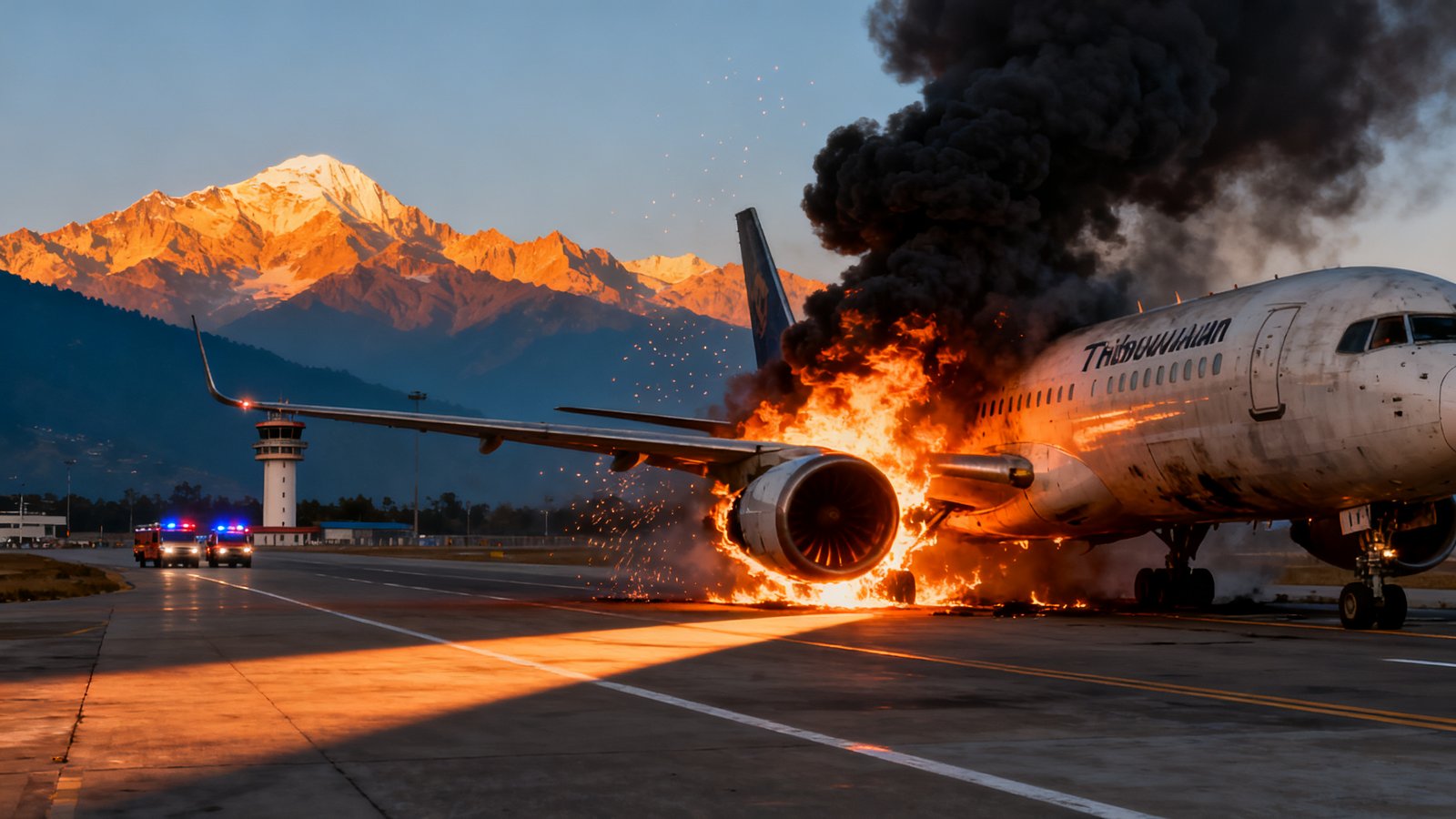
That’s exactly what happened last Wednesday, February 4, on a Saurya Airlines flight. An engine, one of the big powerful things meant to get you off the ground, reportedly just decided to ignite during takeoff. Think about that for a second. You’re hurtling down the runway, picking up speed, gravity’s about to lose its grip on you, and suddenly, one of your primary propulsion systems is doing its best impression of a campfire.
Four Minutes to Mayhem or Miracle?
Four minutes. That’s the reported window this whole terrifying dance played out in. From the moment the fire was spotted to when that plane, thank God, was safely back on the tarmac. Four. Minutes. Can you even imagine? Most of us can barely decide what to order for lunch in four minutes, let alone navigate an emergency landing with a flaming engine.
Pilots, man. They’re a different breed. I mean, we all complain about airline food (or lack thereof these days), the cramped seats, the delays. But then you hear a story like this, and you remember who’s actually up there, making split-second decisions that keep hundreds of lives from becoming just another statistic. This wasn’t a drill, this was big. Really big. And they pulled it off. No injuries. None. That’s just… incredible, if I’m being honest.
The Tribhuvan Tightrope
Tribhuvan isn’t exactly known for being an easy airport. It’s nestled in a valley, surrounded by mountains. It’s got its own challenges on a good day, let alone when you’re dealing with an actual, honest-to-god engine fire. So, for those pilots to react, troubleshoot, communicate, and land that bird without a single scratch on any of the passengers or crew? That’s not just good piloting, that’s like, superhero-level stuff. It just is.
Who Cares About Routine When There’s Fire?
Look, we’re all so used to air travel being this mundane thing, right? You show up, you wait in line, you get patted down, you sit, you fly. It’s just a part of modern life. We rarely stop to think about the sheer complexity of it all, the millions of moving parts, the constant vigilance required. But then something like this happens, and it snaps you right out of that complacency.
“The margin for error in moments like these isn’t just thin; it’s practically invisible. It takes an absolute mastery of craft, and a bit of nerve, to bring everyone home.”
It reminds you that for all the automation and all the safety protocols (which, let’s be clear, are absolutely vital), there are still human beings at the controls. And when the chips are down, when the unexpected, truly catastrophic thing happens, it’s those human beings who make the difference. Who cares about who’s usually in charge of the beverage cart when the engine’s on fire, you know? It’s the people flying the plane, full stop.
The Anatomy of a Near-Disaster Avoided
So, what actually goes down in those four minutes? It’s not just “Oh, fire, let’s land.” There’s a whole checklist, a series of rapid-fire decisions. First, recognizing the issue. Then, confirming it. Shutting down the affected engine. (Imagine the guts that takes – intentionally turning off an engine mid-takeoff!) Then, probably some frantic communication with air traffic control, diverting other planes, clearing the runway. And all while maintaining control of a massive metal tube that’s now a little less balanced and a lot more stressed.
And then, the landing itself. An emergency landing isn’t just a regular landing. It’s often faster, harder, and requires even more precision, especially when you’re dealing with a compromised aircraft. The fact that they brought it down smoothly enough that everyone just walked off, probably a bit shaken but physically unharmed, speaks volumes. It really does. I’ve seen patterns before where smaller incidents spiral because the initial reaction wasn’t perfect. This was perfect.
What This Actually Means
This isn’t just another news story about a plane having a problem. This is a testament to training. To experience. To the absolute necessity of having top-tier professionals in the cockpit. It’s easy to get cynical about airlines, about corporate corners being cut, about the relentless pursuit of profit. And sometimes, yeah, those criticisms are valid. But then you get a stark reminder that at the core of it all, there are these incredible individuals who, when tested, rise to the occasion in ways that frankly, most of us can only marvel at.
It’s a wake-up call, too. A reminder that even with all our technological marvels, the world is still a messy, unpredictable place. Things break. Things catch fire. And sometimes, you just need a few really, really good people to pull you out of the fire, literally. So next time you’re on a plane, maybe take a moment. Appreciate the view. And maybe, just maybe, send a little silent thanks to the folks up front. They’re doing more than just getting you from A to B, they’re often performing miracles you never even hear about… until something like this happens. And this time, we heard about it. And it was a good one.